Stanford Researchers Integrate Human Brain Organoids into Mouse Cortical Circuitry
According to BBC reporting, Prof Sergiu Pașca's team has engineered mice with almost none of their own cerebral cortex, then implanted human brain organoids that wired themselves into the host's…
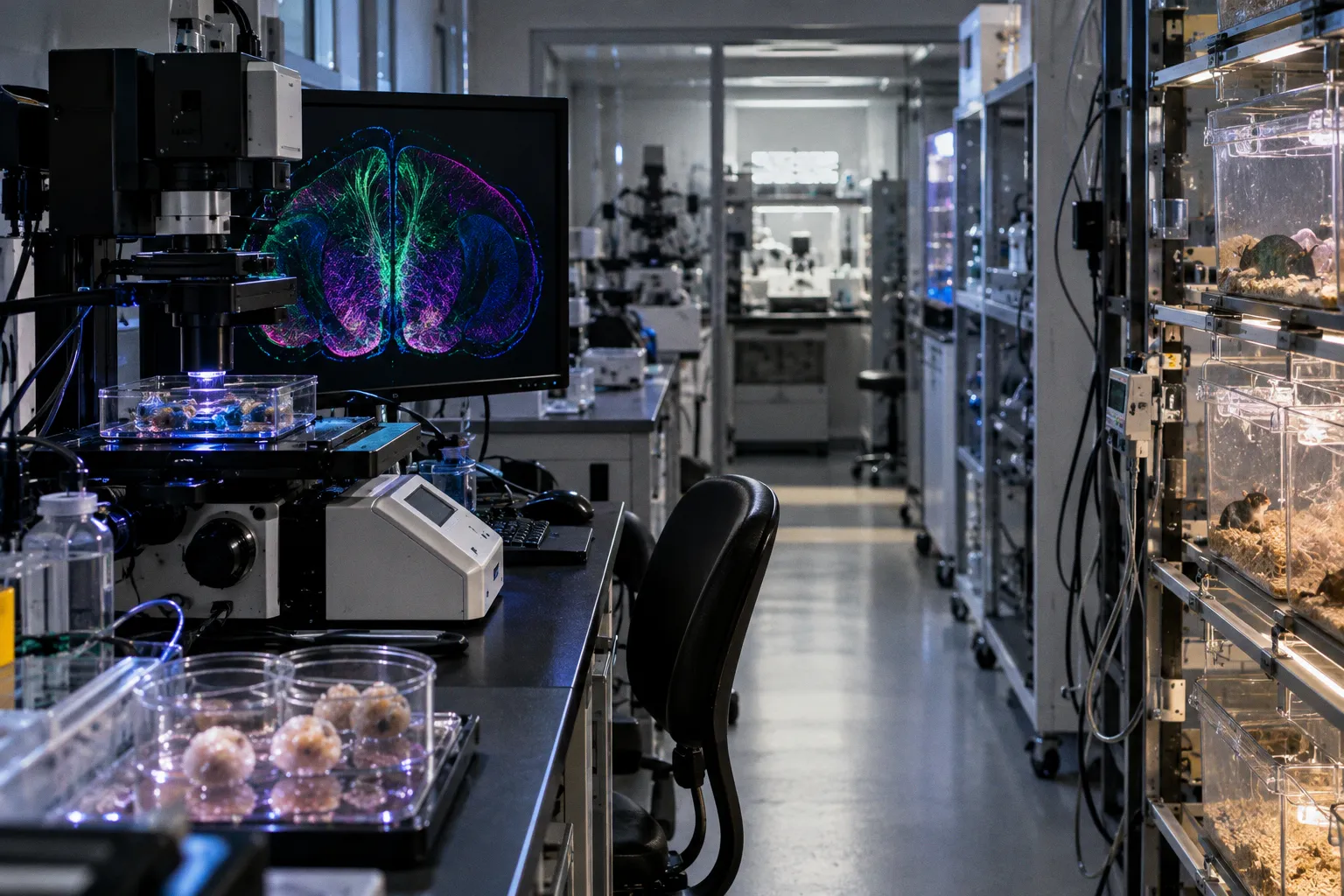
If you've ever sat at your bench wondering why a beautifully clean organoid protocol suddenly stops talking to the rest of the tissue around it, the new Stanford chimera work will catch your eye. According to BBC reporting, Prof Sergiu Pașca's team has engineered mice with almost none of their own cerebral cortex, then implanted human brain organoids that wired themselves into the host's existing circuitry over the course of months. For any of us working on circuit formation in zebrafish and other in vivo models, it's the kind of result that makes you both jealous of the prep and genuinely thoughtful about what "integration" really means.
What actually happened at the bench
The Pașca group did something most of us would file under "too ambitious for a Tuesday." They genetically engineered mice to develop almost no cortex of their own — that outer layer we usually lean on for higher-order function, memory, sensory integration, all the good stuff. Then they took human skin cells, reprogrammed them, and grew them into brain organoids: not whole brains in a dish, more like connected collections of living cells.
Those organoids went into the mouse cortex. Months later, the human cells had divided, organized, and started talking to the host brain and spinal cord. Behaviorally, the mice performed largely as normal mice do in arena tests — Pașca was clear in his press conference that these are not "mice that think like humans," and the cortex scans themselves look, as neuroscientist Dr Ilary Allodi described them, "a bit messy" compared to the clean laminar architecture we're used to seeing on a stained section.
The point wasn't pretty lamination. It was capturing human-specific biology — a serious gap, since, as Pașca noted, even drugs that look great in animal models often fail dramatically once they reach the clinic.
Why your zebrafish prep should care
Here is where I want you to lean in. The same Stanford group also pushed out a developmental story this month arguing the vertebrate brain does not come from one progenitor source, but from two distinct neural ectoderm populations — and they showed the mechanism is conserved across chickens, zebrafish, and acorn worms.
Read that again. Zebrafish.
So while the chimera paper is grabbing the headlines, the quiet companion finding is the one our bench notebooks should be flipping open for. If the dual-origin plan is conserved in zebrafish, then your standard neural tube staging, your progenitor marker cocktails, and even the mutant phenotypes you've been curating might be conflating two cell populations you have been scoring as one. That's a real prep-level concern, not a philosophy question. For anyone doing circuit tracing in larval zebrafish, the practical worry is whether your "single-source" fate maps are actually picking up two populations — and whether that is the source of the stubborn noise floor in your connectivity data that no amount of denoising seems to fix.
What to track before you redesign anything
A few things worth keeping in your head before you rewrite any pipeline:
- The chimera behavior was described as "largely as [the normal] mice did," which is reassuring but is not a deep cognitive battery. Watch for replication and proper electrophysiology follow-ups.
- Independent ethical scrutiny was a stated part of the work. Any human-into-animal chimera anywhere on your horizon will need the same scaffolding, so start those conversations now rather than later.
- The dual-origin developmental story is brand new and pre-press in many corners of the field. Sit on it for a beat, but start flagging which of your existing zebrafish lines might show the cleanest split between the two progenitor pools.
Let's not pretend this is a quiet week in neurobiology. But the actionable part for our benches is not the human-mouse headline — it's the zebrafish-relevant result sitting quietly next to it. Go pull up the dual-origin paper, mark up your stage diagrams, and let's see which of your old phenotypes suddenly start making a lot more sense.