Human Neurons in Rodent Brains: New Frontiers in Neural Circuit Research
The BBC reports that Stanford neuroscientists have built a hybrid cortex inside living mice: human neurons, derived from reprogrammed skin cells, integrating into rodent brain circuits in ways that organoids in a dish simply cannot.
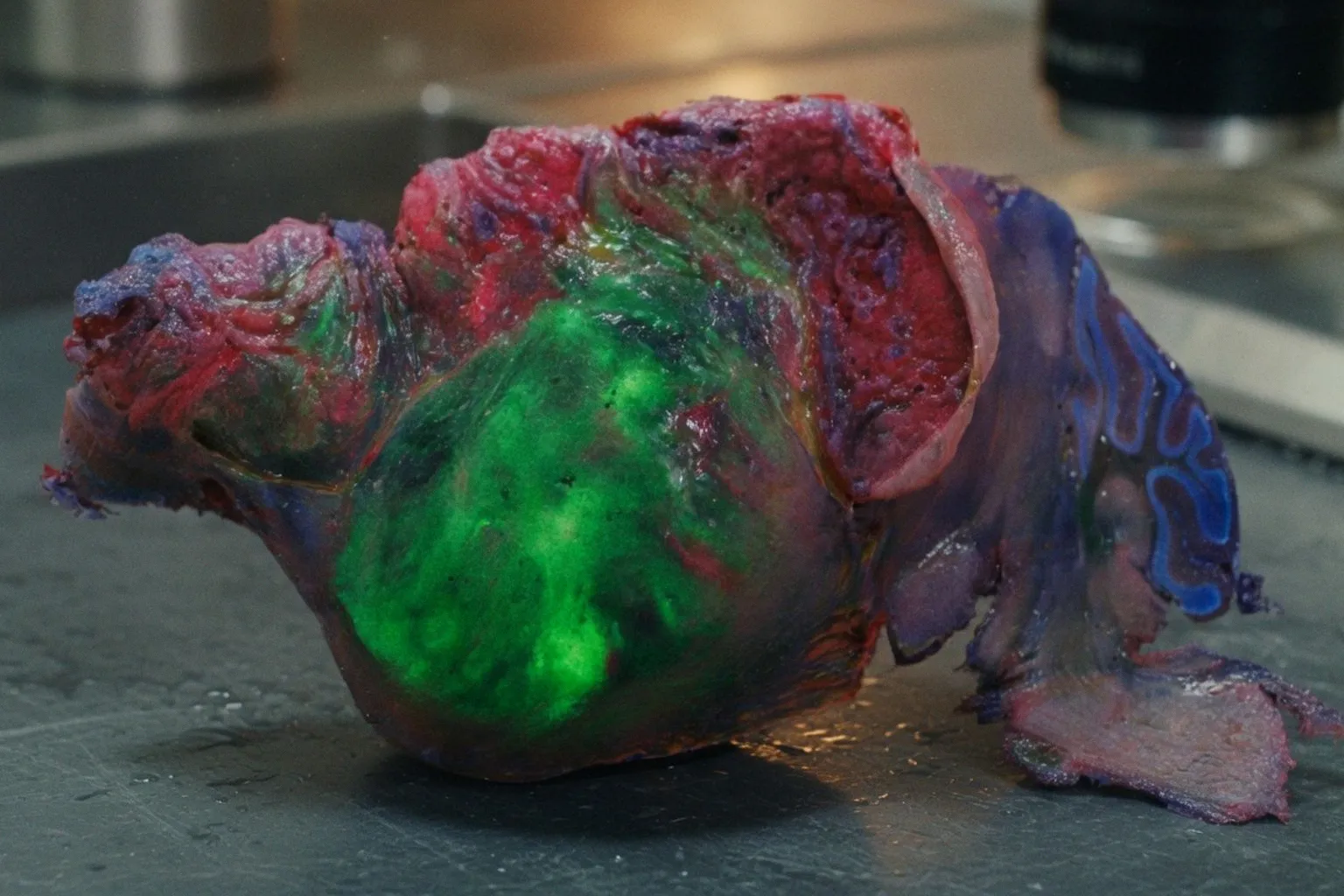
For anyone studying how neural networks actually assemble, the experiment reframes a familiar question — not how cells can connect in principle, but how they do once embedded in a living system with blood flow, glial support, and competing axons.
A messy circuit, deliberately built
The method begins with subtraction. Researchers engineered mice to develop almost none of their own cerebral cortex — the outer layer that handles higher-level cognition, memory, and sensory integration. Into that vacancy they implanted organoids, clusters of living human cells already organized into rudimentary networks. Within the mouse brain, the human cells divided, migrated, and threaded themselves into the animal's existing circuitry, extending connections down into the spinal cord.
Scans of the resulting brains, as neuroscientist Ilary Allodi observed, look "a bit messy." Normal cortex forms tidy, layered columns. The hybrid tissue does not. Yet after several months, the human cells began to take on the functional character of the surrounding mouse cortex — a slow assimilation of cellular identity, shaped by the local circuit rather than the cells' species of origin. The work, carried out with independent ethical scrutiny, was published in the journal Nature.
Why network formation researchers should care
Lead researcher Sergiu Pașca framed the project as a response to psychiatry's notoriously low clinical-trial success rate: animal models often behave as if a treatment works, then the therapy fails in humans. The underlying gap, he suggested, is missing biology — specifically, the kinds of neurons and circuits that only human tissue builds. For conditions such as epilepsy, autism, and cerebral palsy, where rodent models cannot reproduce the disorder, a hybrid circuit offers a different kind of access.
For those who track neural network formation, three details matter most. The human cells integrate into existing circuitry rather than forming isolated islands. The integration is incomplete, with no clean laminar architecture. And the hybrid circuit becomes functional only over months, not weeks. Any model of network assembly built from this work must account for a process that is gradual, structurally imperfect, and responsive to its host environment.
A principle to carry forward
When human cells are placed inside a living mouse brain, they do not arrive as miniature human circuits. They arrive as cells, and they become what the local network permits. For neural network research, the lesson is structural: connectivity is not a property of a cell type alone, but of the circuit a cell finds itself inside.