How Neural Manifolds Reorganize to Encode Learned Odors in Zebrafish
According to researchers at the Friedrich Miescher Institute, a zebrafish's brain does not pin a memory to one place on the cortical wall like a pinned butterfly.
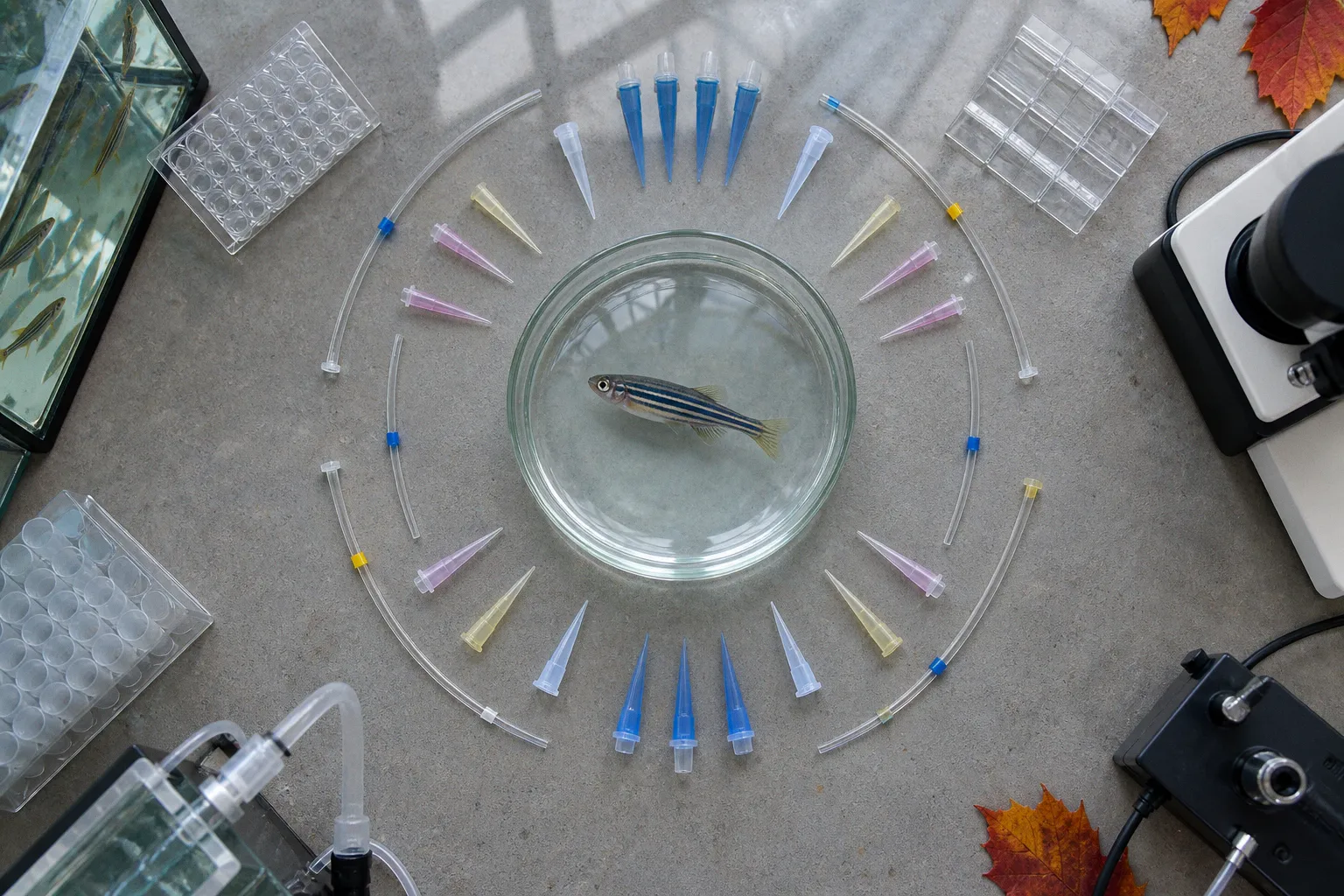
The Smell That Learned a New Shape
Instead, learning to recognize a meaningful odor gently reshapes the geometry of population activity across hundreds of neurons, stretching the distance between what matters and what does not.
Manifolds That Separate
The team, led by Rainer Friedrich, trained juvenile and adult zebrafish to associate one odor with food while leaving a second scent unrewarded. After conditioning, the fish reliably swam toward the feeding zone when the learned odor entered the water, a clean behavioral readout that the association had taken hold. When the researchers then recorded from telencephalic area pDp — the zebrafish homolog of mammalian piriform cortex — they found no stable, attractor-like pattern anchored to a specific scent. Instead, activity drifted each time the same odor arrived, dissolving again within seconds of its disappearance.
The signal sat somewhere quieter: in the shape of the neural manifold. Picture each moment of population activity as a single point drifting through a high-dimensional cloud. After learning, the clouds belonging to the rewarded odor and the unrewarded odor drifted apart. The geometry of the space itself reorganized, so the brain no longer had to guess which point meant dinner.
A Capacity You Can Measure
Friedrich's group joined forces with theoretical neuroscientist SueYeon Chung, whose framework for manifold capacity makes that geometry countable. Her team's analytical tools revealed several geometric modifications clustered around the task-relevant odors, each one pushing the relevant manifolds further from the irrelevant ones. Most strikingly, manifold capacity scores predicted behavioral performance: fish whose manifolds had separated more cleanly were the same individuals that distinguished the odors fastest and most reliably.
This turns manifold geometry into something closer to a cognitive thermometer — a measurable property of a recurrent network that maps onto behavior. For zebrafish neurobiology, where the entire organism is optically accessible during circuit-level recording, the result offers a working playbook. Memory, in this circuit, is not a painting hung in a corridor but a room whose walls move each time the animal learns.
What to Watch in the Model
The findings, published in Nature, suggest that recurrent networks like pDp store information by adjusting the geometry of their activity space rather than carving out discrete engram cells. For laboratories studying neural network formation, the next move is clear: track the manifold, not the single neuron. Where separation grows, learning is taking place. Where separation fails to grow, the circuit has not yet found its shape.