WILD Datalogger Enables High-Resolution Neural Recording in Natural Environments
For the past two decades, the wiring of a behaving brain has been a surveillance problem: either you accept the cable, or you accept the blur. According to a study published Sept.
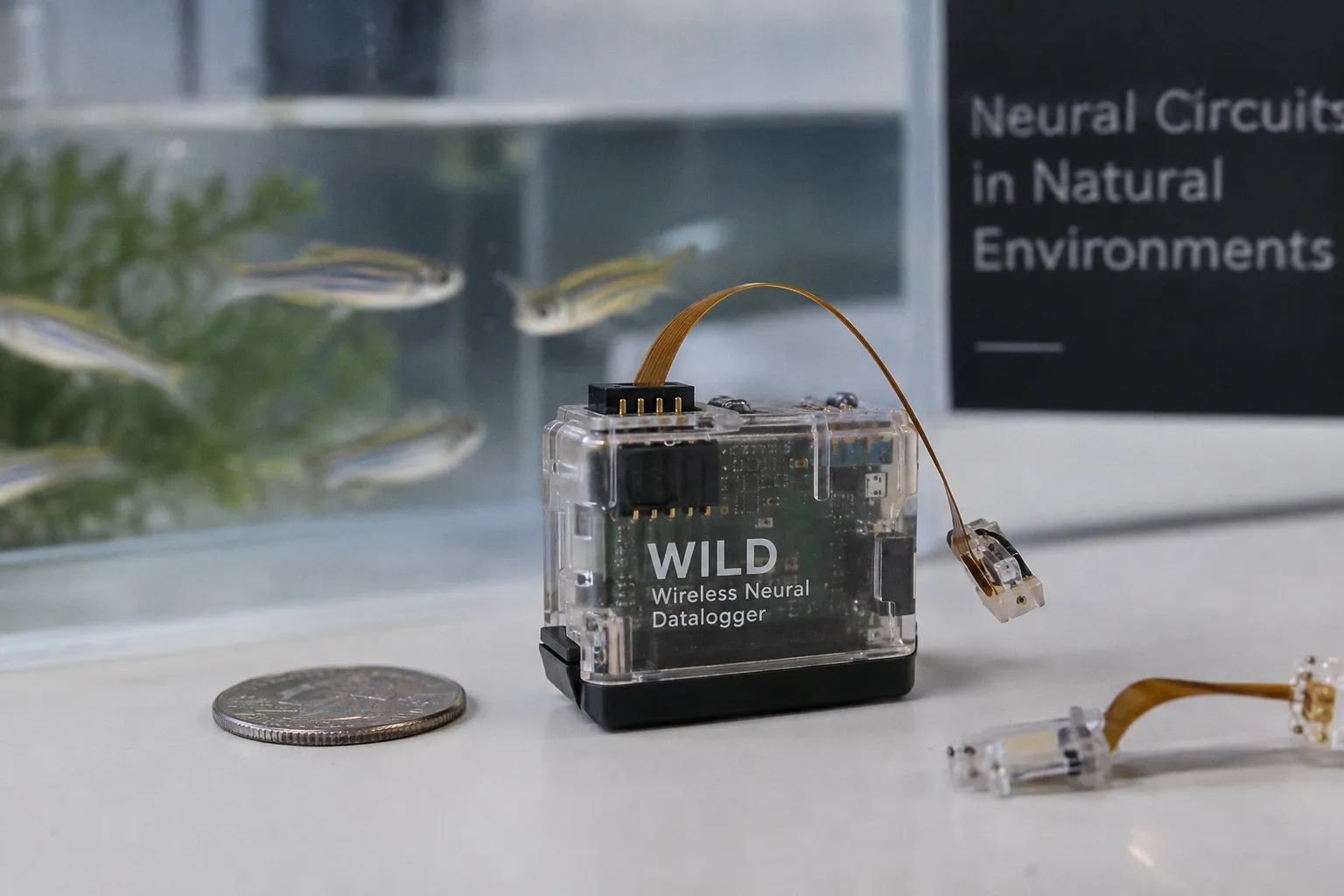
10 in Nature Methods, a Cornell team has chosen neither.
The device is called WILD — Wireless, Interactive, Lightweight Datalogger — and it weighs less than a U.S. dime, molded into a shape the designers describe as a tiny chef's hat. Flexible probes sit beside interchangeable modules that can drive neurons with light or current, log locomotion and orientation, record vocalizations, and track eye movements. WILD compresses a multi-channel electrophysiology rig into something a mouse can carry through a field enclosure for more than two weeks at a stretch, recording continuously for three to nine hours depending on battery size, or far longer if the firmware idles while the animal sleeps.
What changes when the cable disappears
Co-senior author Azahara Oliva, an assistant professor of neurobiology and behavior at Cornell, frames the breakthrough as a shift in scope: the system still captures high-resolution neural data, but now inside the contexts where the behavior actually unfolds. In field trials just north of campus, the team captured the first recordings of hippocampal place cells activating as mice moved through and internalized a large outdoor arena. Co-senior author Antonio Fernandez-Ruiz, also of neurobiology and behavior, observed that the cells share some properties with their lab-recorded counterparts — but diverge meaningfully, a divergence the group is now following up in dedicated studies.
That second sentence is the one that matters for circuit neuroscientists who work in tanks, plates, and multi-well rigs. It suggests that place representations are not a fixed map but a context-shaped construct, and the only way to read that map faithfully is to record while the animal is building it.
A modular chassis worth watching
WILD is not a monolithic implant; it is a frame with swappable payloads — recording, optogenetic or electrophysiological drive, behavioral sensors. That modularity is where the practical leverage lies. Collaborators are already adapting the platform for birds, bats, and monkeys, and the same architecture implies that other small vertebrate systems are a plausible next step, though the present paper describes no configuration outside the rodent pipeline.
A few points the working neuroscientist should hold in mind before treating WILD as off-the-shelf infrastructure:
- Recording is bounded by battery. The 3–9 hour continuous window supports most acute and sub-acute paradigms; duty-cycling can extend runtime substantially.
- The electrode array is flexible, but probe pitch and depth set which cell layers can be sampled, and the field-validated configuration targets cortical and hippocampal populations.
- Closed-loop logic is built in. The device can be programmed to deliver stimuli when it detects specific neural or behavioral patterns — useful for probing sensorimotor loops without tethering the animal to a rig.
Why this reads as infrastructure
For a generation trained on head-fixed rigs and virtual corridors, the most consequential detail is not the weight or the wireless link — it is the protocol embedded in the device. WILD lets a question like "what does a hippocampal ensemble encode during nest-building?" leave the laboratory and become a field experiment. For circuit labs bottlenecked by tether length, the next frontier is less about better silicon and more about better experimental design: choosing the right natural context, calibrating place fields against lab benchmarks, and treating the differences between lab and field activity as a signal worth decoding rather than noise to average away.
Until now, those questions lived in the discussion sections of papers, framed as future work. With WILD, they have moved into the methods.