WHOLISTIC Imaging Platform Tracks Neural and Organ Signaling in Living Zebrafish
WHOLISTIC, as summarized by The Times of India and the Nature index entry, is positioned as a whole-organism imaging approach built around the optical transparency that already makes larval zebrafish our favorite prep.
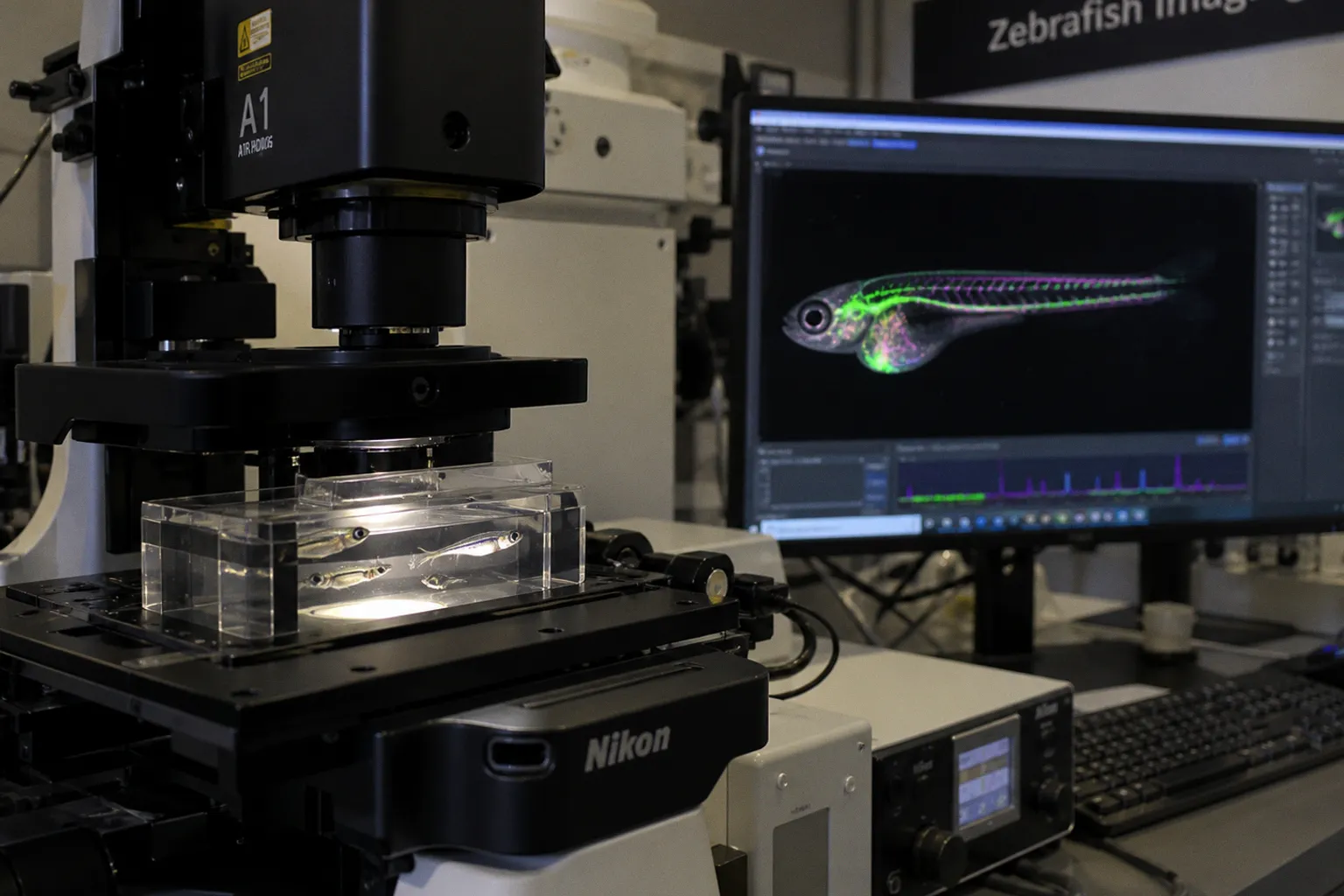
You've spent three months trying to get a clean two-photon stack of a behaving larva without the tail jitter wrecking your registration, and now a team reports a system that aims to record basically the whole animal in one shot. According to coverage in Nature, a new live imaging platform called WHOLISTIC tracks organ-wide and neural signaling in transparent larval zebrafish while they swim, feed, and rest — the first approach, as described, that captures whole-body intercellular communication in a living vertebrate. For anyone of us who has had to choose between sampling the brain, the spinal cord, or the gut in a single prep, that framing alone is worth sitting up for.
What the platform is actually doing
Let's be honest about what we know from the reporting so far. WHOLISTIC, as summarized by The Times of India and the Nature index entry, is positioned as a whole-organism imaging approach built around the optical transparency that already makes larval zebrafish our favorite prep. The claim is that you can follow neural and organ-level signaling across the same animal during naturalistic behavior — not a fixed larva in agarose, not a dissected brain, but an intact vertebrate doing vertebrate things.
That distinction matters. Most of the "whole-brain" tools we use today still ask the fish to hold still, or they stitch together sparse samples that miss the coordination between brain, body, and viscera. A system pitched at tracking activity across nearly every cell of a living vertebrate at once is, on paper, exactly the kind of bridge our field has been begging for between cellular-resolution circuits and organism-level physiology.
Where the excitement meets the bench
Here's where my PI brain kicks in and I want you to be careful with me. A press-cycle headline is not a protocol. We don't yet have confirmation of the optical depth, the effective cell yield, the sampling rate, or how the team handled motion correction for an animal that is freely behaving — and those are precisely the numbers that decide whether this slots into your workflow or stays in someone else's fish facility.
What I'd watch for in the full Nature paper and any subsequent methods releases:
- Signal vs. noise at depth. Whole-body calcium or voltage imaging sounds glorious until phototoxicity and out-of-focus blur eat your SNR in the dorsal brainstem and gut.
- Behavioral coupling. The promise of capturing "move, eat, and rest" only holds if the acquisition rate actually resolves those events. If frame rate is sacrificed for coverage, your circuit conclusions will quietly shift.
- Cross-organ registration. The interesting biology here is intercellular communication between organs. We need to see how cell calling, vascular signals, and neural activity are temporally aligned before we start drawing wiring diagrams.
- Replicability. Is this a custom rig, a kit, a service, a preprint-plus-toolbox? Your ability to test it depends entirely on the answer.
What this changes for your next grant aim
Practically, even if WHOLISTIC doesn't land on your bench this year, the conceptual move is the part I'd steal for your writing. For the past decade we've been trained to fragment the zebrafish into "brain projects," "gut projects," "heart projects." A platform framed around whole-body intercellular communication is a gentle reminder that the animal does not partition itself that way, and your next specific aim probably shouldn't either.
So — read the paper, screenshot the supplemental figures, and start asking whether the question you've been answering with a head-fixed prep is actually a whole-body question in disguise. That's usually where the interesting biology has been hiding all along.