How Zebrafish Brains Reveal the Universal Logic of Sensory Processing
A new study published in Science, as reported by Medical Xpress, gives us something better than commiseration: it maps how a young zebrafish brain actually decides what belongs together in the world…
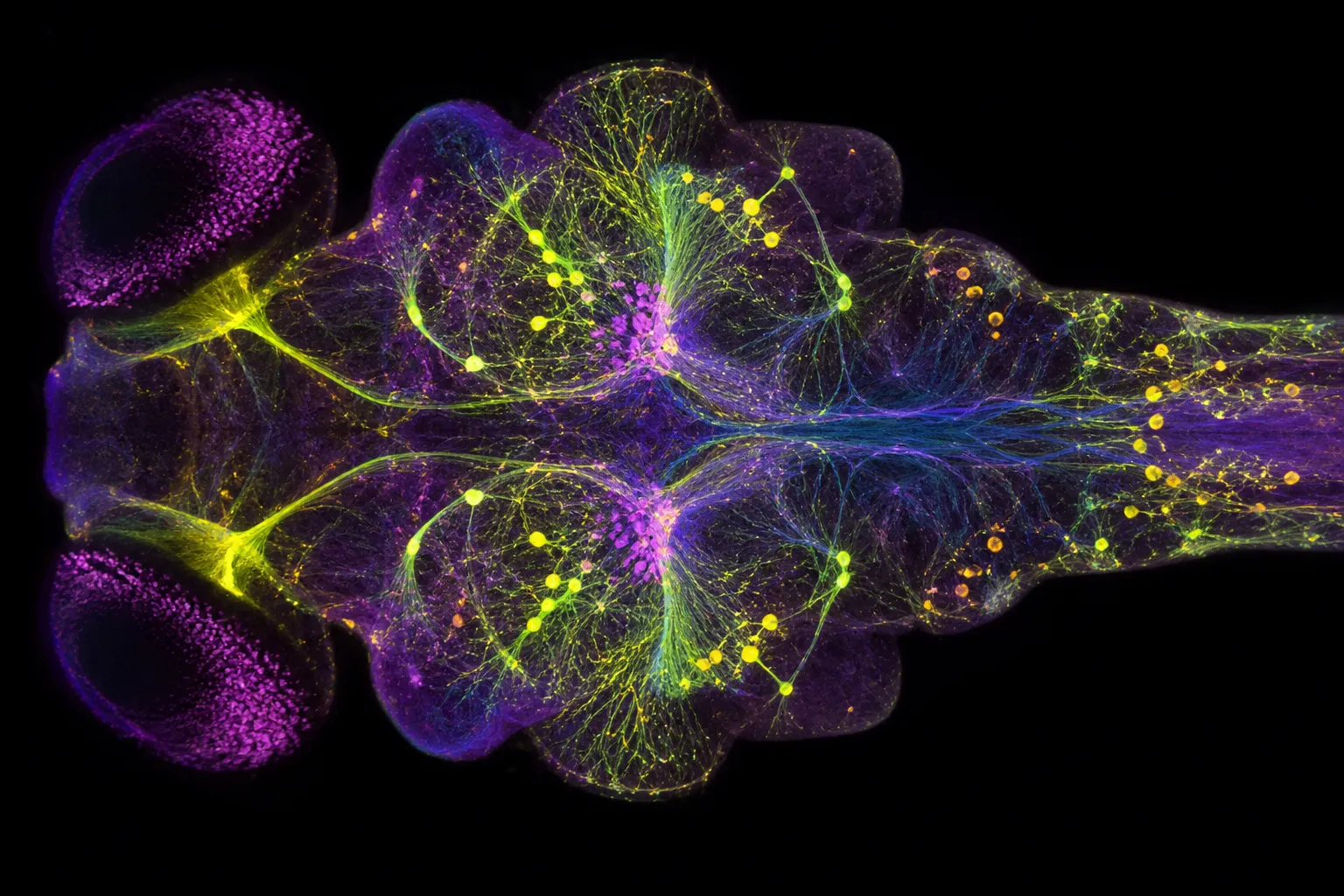
Let's be honest — how many of you have spent an entire afternoon chasing a weird result in your zebrafish imaging prep, only to realize the stimulus presentation was the noise polluting your clean signal? Yeah, me too. A new study published in Science, as reported by Medical Xpress, gives us something better than commiseration: it maps how a young zebrafish brain actually decides what belongs together in the world, and the hierarchy looks remarkably like our own.
What the team actually saw under the scope
Led by Professor Emre Yakşi at the Norwegian University of Science and Technology — he's also visiting faculty at Koç University — the group asked whether the layered sensory logic we associate with mammalian thalamocortical circuits has an analog in fish. They presented larval zebrafish with visual stimuli plus water-borne vibrations, then watched activity flow into the forebrain using advanced neural imaging and circuit-mapping. The short version: the preglomerular complex — PG, your new favorite acronym — is the relay hub feeding visual and vibrational signals into the pallium, the fishy evolutionary cousin of our cortex.
Why your next prep should care
Here's the part that should change how you design your next experiment. Early in the pathway, vision and vibration stay in separate lanes and land in distinct regions of the pallium. Deeper in, things get messy in the best way — some neurons respond to one modality only, others integrate both, and a third class barely fires to either stimulus alone but lights up when they coincide. Those nonlinear, coincidence-detecting cells are doing exactly the kind of multisensory binding that makes perception feel unified instead of fragmented, and they may be the very population that tells the brain whether two separate signals belong to the same event.
What to watch at the bench
If you're working with larval zebrafish and you're still treating visual and mechanosensory stimuli as independent channels in your analysis, this is your cue to recheck your assumptions. Both sensory modality and spatial location are encoded in the PG→pallium projection, so your region-of-interest selection and your stimulus timing may be introducing exactly the confounds you've been trying to eliminate. Pull those coincident-firing neurons out of your dataset and treat them as your cleanest readout for multisensory integration. And the next time a reviewer asks why your fish imaging only uses one modality — point them straight at this paper. Let's see what the zebrafish brain can teach us when we actually let it integrate.