Google Maps the Complete Neural Connectome of an Adult Fruit Fly
According to Tom's Hardware, Google Research, working with HHMI Janelia Research Campus, announced the first-ever full reconstruction of an adult male Drosophila brain and central nervous system.
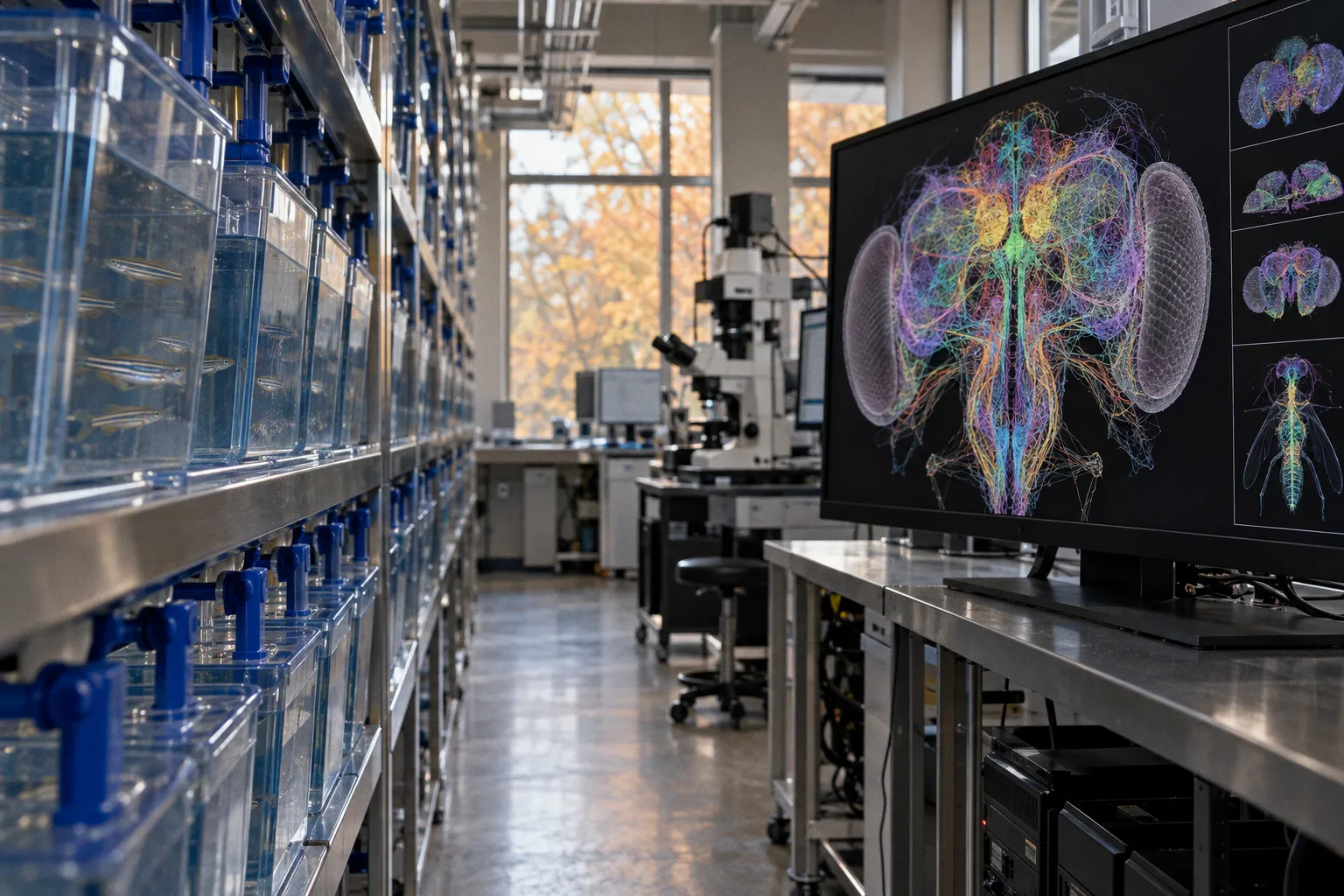
A complete map of the adult fruit fly nervous system has arrived, and within days of its release, software engineers were already wiring the 166,000-neuron connectome into classic video games. According to Tom's Hardware, Google Research, working with HHMI Janelia Research Campus, announced the first-ever full reconstruction of an adult male Drosophila brain and central nervous system. The achievement relied on AI to fuse millions of two-dimensional electron microscopy images into three-dimensional neural shapes, capturing more than 166,000 neurons and the dense tangle of synaptic connections between them.
The circuit under the lens
The fruit fly, a century-old workhorse of genetics and neuroscience, has long been mapped in pieces. What distinguishes this release is completeness: rather than a single brain region, researchers reconstructed the entire central nervous system of one adult male. For the circuit community, that continuity matters less as a numerical trophy than as a structural substrate, a wiring diagram dense enough to ask how a behaving animal is actually assembled.
The contrast with our own cortex sharpens the visual. Where the human brain sprawls across roughly 86 billion neurons, the fly offers an unusually high signal-to-noise ratio for tracing individual connections. In practical terms, the dataset gives labs a continuous anatomy to overlay onto functional recordings, the kind of ground truth that circuit models have been missing for decades.
From connectome to console
Within days, the dataset was being run as if it were a graphics engine. Software engineer Alex Wormuth began training the full MaleCNS v1.0 connectome on Doom, mapping each frame's sensory neurons onto game controls and using damage signals to stimulate PPL101 dopamine cells as reinforcement. Engineer Jessica Paquette, by Tuesday, was running Super Mario 64 on the same circuit, though the on-screen result so far resembled a fly repeatedly bumping into a window.
The code is open source, and the 166,700-neuron network is being trained live. For working neuroscientists, the spectacle serves a quiet function: it forces a public conversation about what a connectome actually is, and what it is not.
What to watch next
Two questions will decide whether MaleCNS v1.0 becomes a research instrument or a curiosity. First, whether the AI alignment between 2D sections and 3D volumes holds up under independent replication, and at what error rate per synapse. Second, whether the open code can be coupled with behavioral recordings that show these neurons firing in the patterns the map predicts. Without that second step, even a perfect wiring diagram remains a static portrait rather than a model of behavior.
For labs working on neural network formation, the practical move is modest but clear: download the dataset, interrogate the segmentation in your own region of interest, and resist treating the connectome as a behavior engine until the functional data catches up.