Ancient Brainstem Circuits Control Selective Attention in Mammals
Selective attention used to be mapped primarily to cortical networks. New work from Johns Hopkins recalibrates that map. Lead author Ninad B. Kothari and senior author Shreesh P.
The bottleneck was hiding lower than expected
Mysore identified a group of brainstem inhibitory neurons — parabigemino-lateral tegmental (PLTi) cells — as a functional attentional selection engine. Silencing them via chemogenetics made mice hyper-distractable. The effect was specific: vision, motor control, and basic target identification stayed intact. What collapsed was the capacity to resolve competing signals.
How the circuit was isolated
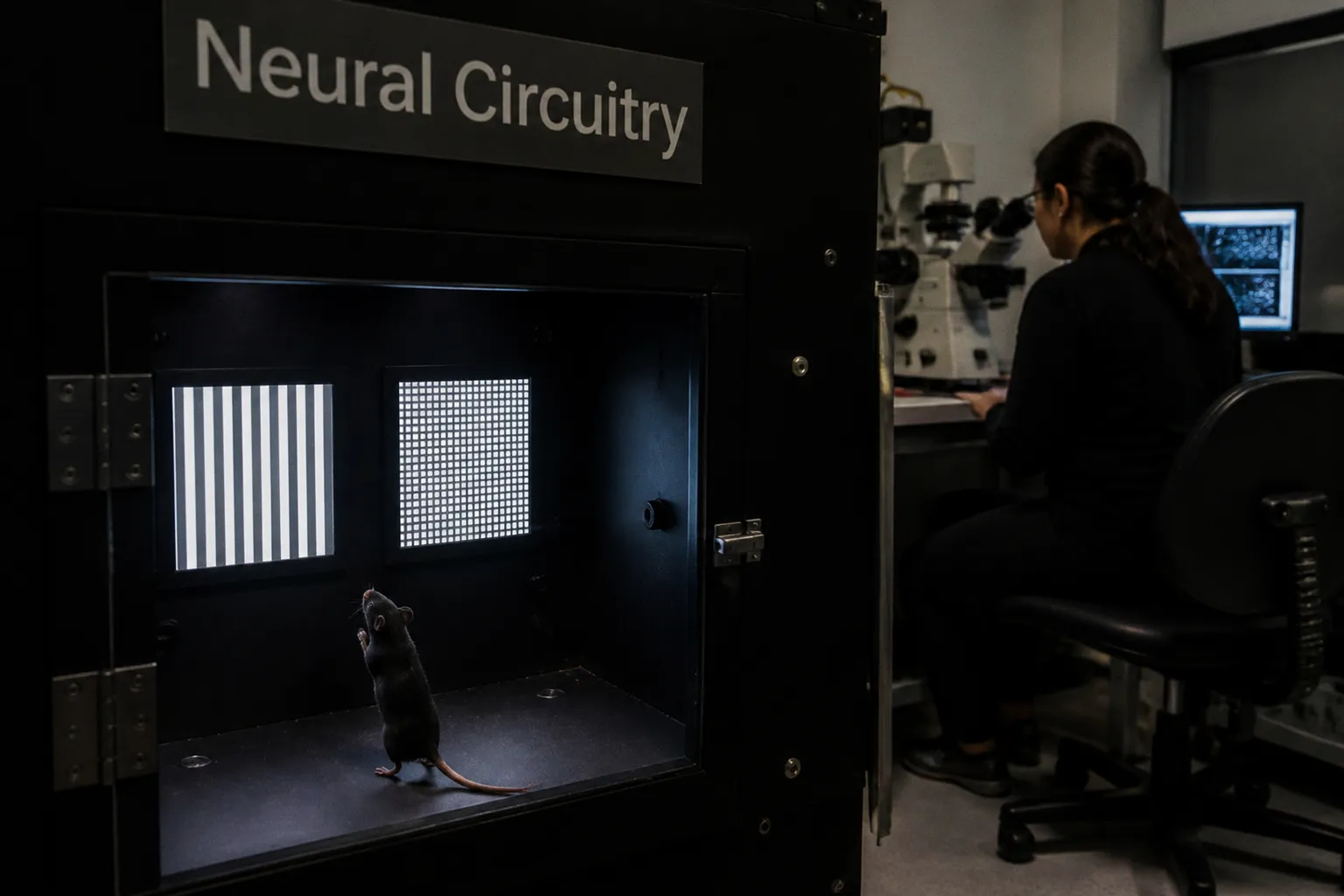
The team used a touchscreen flanker task adapted from a classic human paradigm. Mice identified a central pattern orientation while ignoring a flanking stimulus. Two variables were crossed: distractor salience (how visually prominent) and distractor relevance (whether it carried task-relevant orientation information). When PLTi was bilaterally silenced and targets conflicted with distractors, accuracy dropped sharply — even weak but informative distractions pushed responses off course.
Control conditions locked the mechanism in place. Replace the meaningful distractor with an equally bright but task-irrelevant shape: the impairment vanished. PLTi is not a simple brightness filter. It appears to compute signal-to-relevance ratios in a circuit layer that predates the cortex.
Structural implication for attention models
Evolutionary architecture often preserves redundant subsystems. This study documents one: an ancient brainstem circuit operating in parallel with higher cortical attention networks. The practical question shifts from "where does selection happen" to "how do these layers coordinate — and what breaks when one layer goes offline?" The authors describe PLTi as an attentional selection engine; the data suggest it handles the resolution stage when salience and relevance compete. That maps to real-world distractibility phenotypes in a way cortical-only models struggle to explain.
For anyone modeling attention circuits or building behavioral assays around signal discrimination: PLTi is now a parameter to isolate. If your task separates salience from relevance, you have a direct probe into this brainstem layer. Start there.