Decoding Human Emotion: How Stanford’s Neural Circuitry Program Maps Brain Activity in Real Time
Stanford's Human Neural Circuitry program is recording brain activity at sub-millisecond resolution from patients already admitted for epilepsy monitoring, according to CNN.
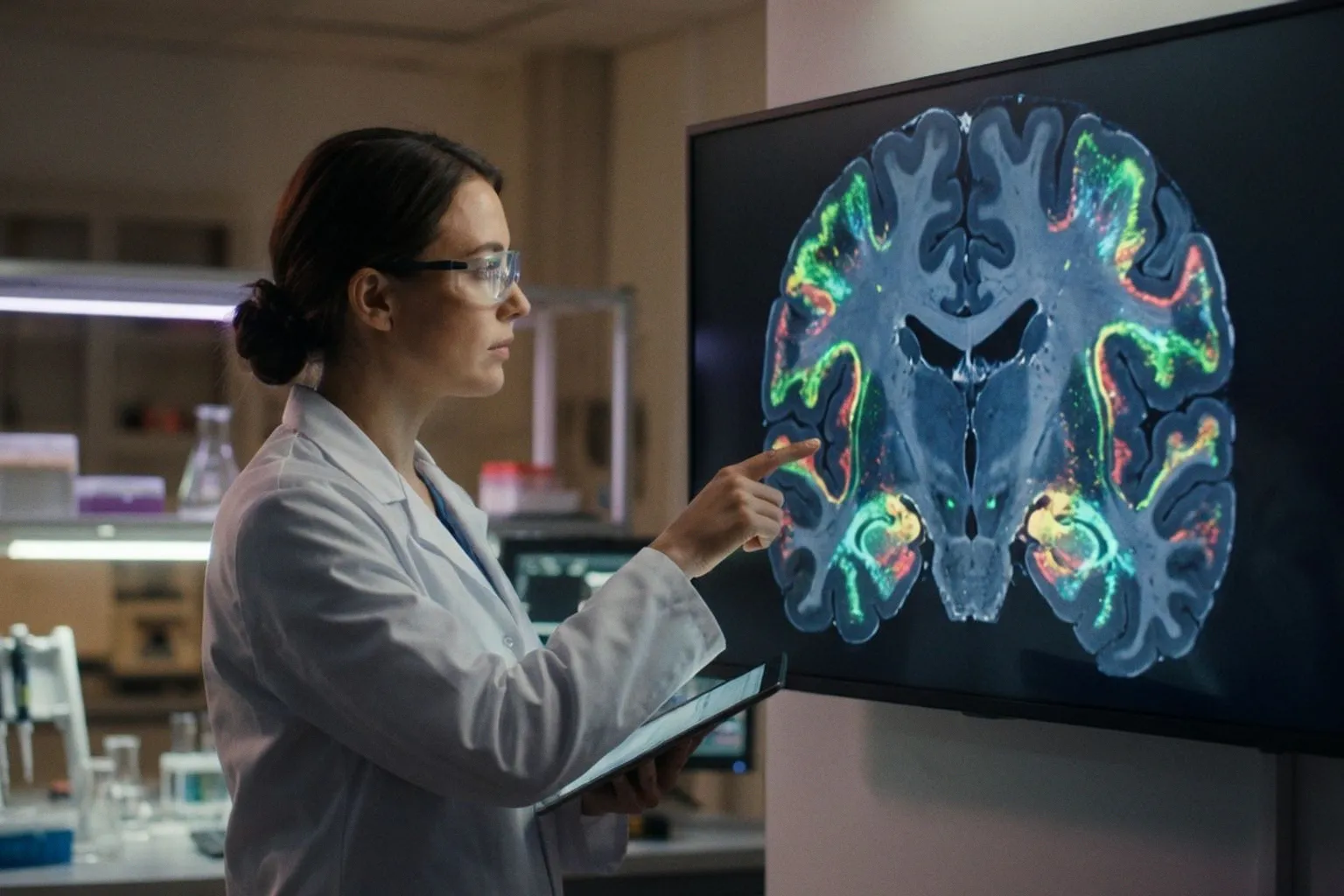
The setup pairs a noninvasive electrode cap with surgically implanted depth leads, then streams the signals across campus through fiber and copper lines with a closed-loop round-trip under half a millisecond. For circuit researchers — even those working in zebrafish or organoids — the engineering envelope is the part worth isolating from the clinical headline.
The recording stack
Two modes, one pipeline. In the noninvasive track, patients wear a shower-cap-like array of electrodes for scalp recording. In the intracranial track, neurosurgeons place and later remove depth electrodes. Both feed the same data path carrying what the program's lead, Karl Deisseroth, calls very large streams with sub-millisecond resolution. The campus servers respond in under 500 microseconds round-trip — fast enough to sense a neural event, compute, and deliver a closed-loop response within roughly the timescale of a single cortical oscillation cycle.
That latency figure is the load-bearing parameter. It separates passive observation from causal experiment: intervene at a specific neural event instead of a guessed window.
What the behavioral frame buys you
The clinical cover — schizoaffective disorder, borderline personality disorder — is secondary to the experimental design. Patients interact socially, listen to narratives, describe sensory responses and internal feelings, sometimes under different medications, all inside a private, naturalistic room. That is the condition set where hypotheses about the circuits of emotion can be quantified against millisecond-aligned neural data and self-report, rather than averaged across task blocks.
For zebrafish and other model-organism work, the methodological takeaway is the alignment problem: timestamped internal-state reports matched to neural events at the same resolution as the recording itself. Few non-human systems can deliver both halves of that equation.
Parameters to track
- Closed-loop latency: confirm it holds below 0.5 ms across sustained sessions and during cognitive load shifts, not only at calibration benchmarks.
- Mode overlap: whether scalp and depth recordings run in the same patients, and at what channel counts.
- Report timing: how internal-feeling responses are timestamped against neural events.
- Pharmacology: which compounds are tested, and how dosing shifts the recorded dynamics.
- Data access: whether processed streams become available outside the host institution.