Evolutionary Biology Reveals the Brain Is Two Distinct Organs Joined Together
Stanford developmental biologists have just handed the field a result that's going to make half of you sigh with relief and the other half groan at all the months you lost to a doomed protocol.
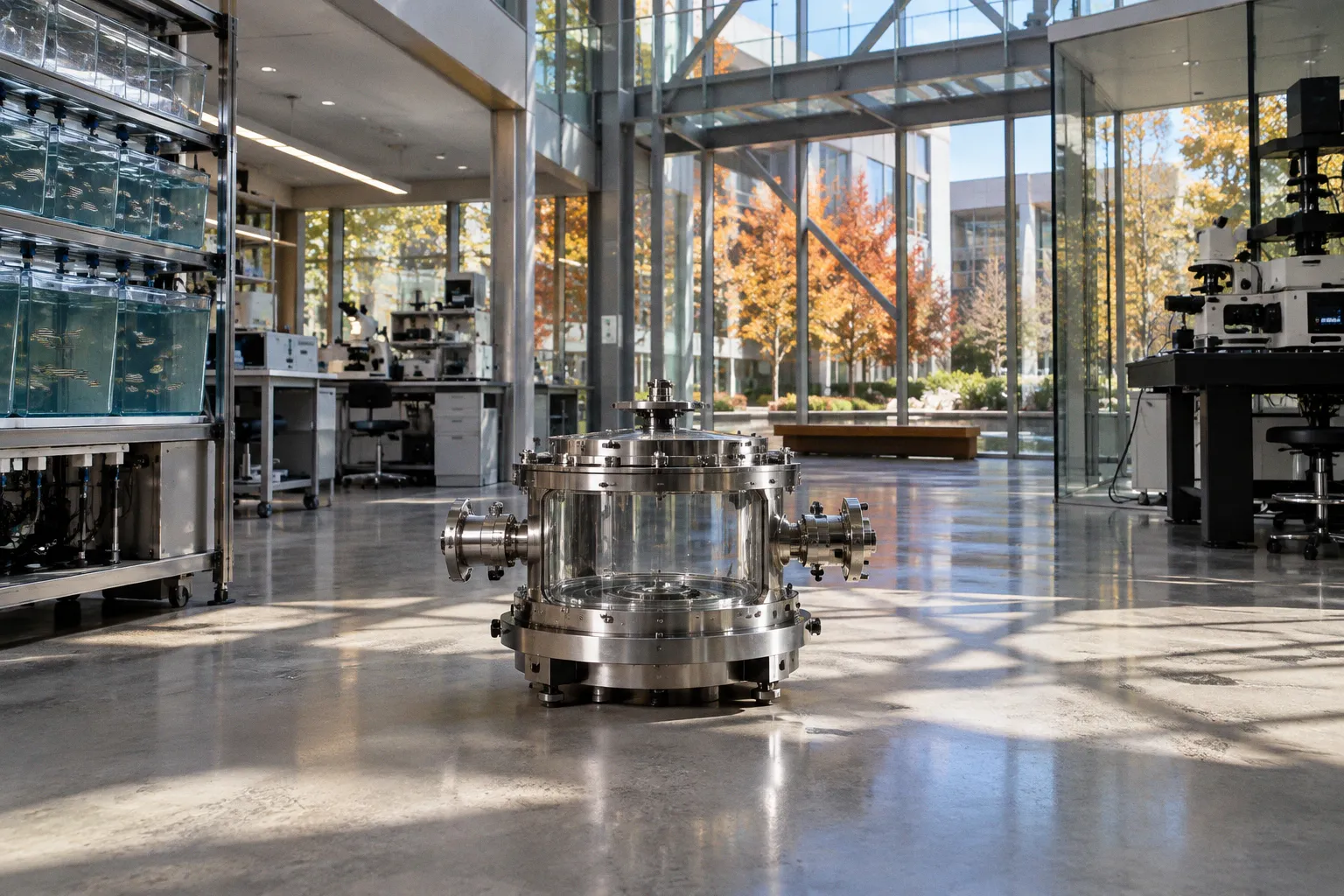
According to a Nature Neuroscience study from Kyle Loh's group at Stanford Medicine, the brain isn't one organ that grew out of a single progenitor pool — it's two ancient nervous systems evolution pinned together side by side. The data settles a debate that's quietly been messing with your hindbrain cultures for years, and the zebrafish folks should pay close attention.
The split you've been fighting at the bench
Here's the scenario I know you've lived through: you set up a beautiful directed differentiation, push your iPSCs toward neural fate, front-load your morphogens to get a motor neuron, and… two weeks later your markers are forebrain. Telencephalon. Cortex. Anything but the brainstem. You blamed the cytokines, the matrix, the passage number, the phase of the moon. You can stop blaming yourself.
The Loh team, with co-first authors Rayyan Jokhai and Carolyn Dundes, walked mouse embryos back to gastrulation and found two completely non-overlapping progenitor populations: an anterior set defined by Otx2 and a posterior set defined by Gbx2. These cells carry distinct chromatin packaging — fundamentally different accessible chromatin from the moment they appear, which permanently locks each into its trajectory. So when your protocol tries to coax a forebrain or midbrain progenitor into a hindbrain cell, you're asking a cell to do something it literally cannot do. That is the noise you've been chasing, and a cleaner cytokine mix was never going to fix it.
Why this matters more because of your zebrafish
This is where I want everyone running a fish facility to put their coffee down for a second. The dual-origin pattern shows up not just in mice. The team confirmed the same Otx2/Gbx2 divide in chickens, zebrafish, and — beautifully — in marine acorn worms, whose lineage split from ours more than 550 million years ago. Jellyfish, which diverged 600 to 700 million years ago, don't even bother fusing the two nets; they run them at opposite ends of the body. Translation: the two-piece brain is the ancestral state, and we vertebrates are the strange ones cramming it all into a single tube.
For anyone using zebrafish to study motor circuits, hindbrain segmentation, or motor neuron disease, that's actually a green light. Your fish's brainstem development is running on the same deeply conserved logic as the human fetal brainstem. The model is more faithful than you assumed — you just have to know which progenitor you're patterning from at the earliest stages.
What to try at the bench this week
The gift of this paper is that the authors didn't stop at the developmental biology. From human pluripotent stem cells patterned through a posterior identity, they generated hindbrain motor neurons that fired action potentials and expressed the segmental markers tied to facial and swallowing motor pools. These are the exact circuits that degenerate in ALS and spinal muscular atrophy, both of which have been stubbornly hard to model in vitro — for the lineage reason this study now explains.
So if SMA, ALS, or brainstem patterning is on your radar, here's your Monday morning move. Trash the anterior induction stage. Repattern from a posterior gastrulation-like identity. Let the chromatin landscape of the right progenitor do the heavy lifting before you start optimizing downstream. The clean signal you want isn't hiding in your cocktail — it's decided before day one. Let's get the prep right, and the endpoints will follow.