Internal Developmental Clocks Drive Brain Organoid Maturation
A new finding from NIH-funded researchers is forcing a parallel conversation in the organoid world, and the implications ripple straight back into how we think about timing in our own in vivo rigs.
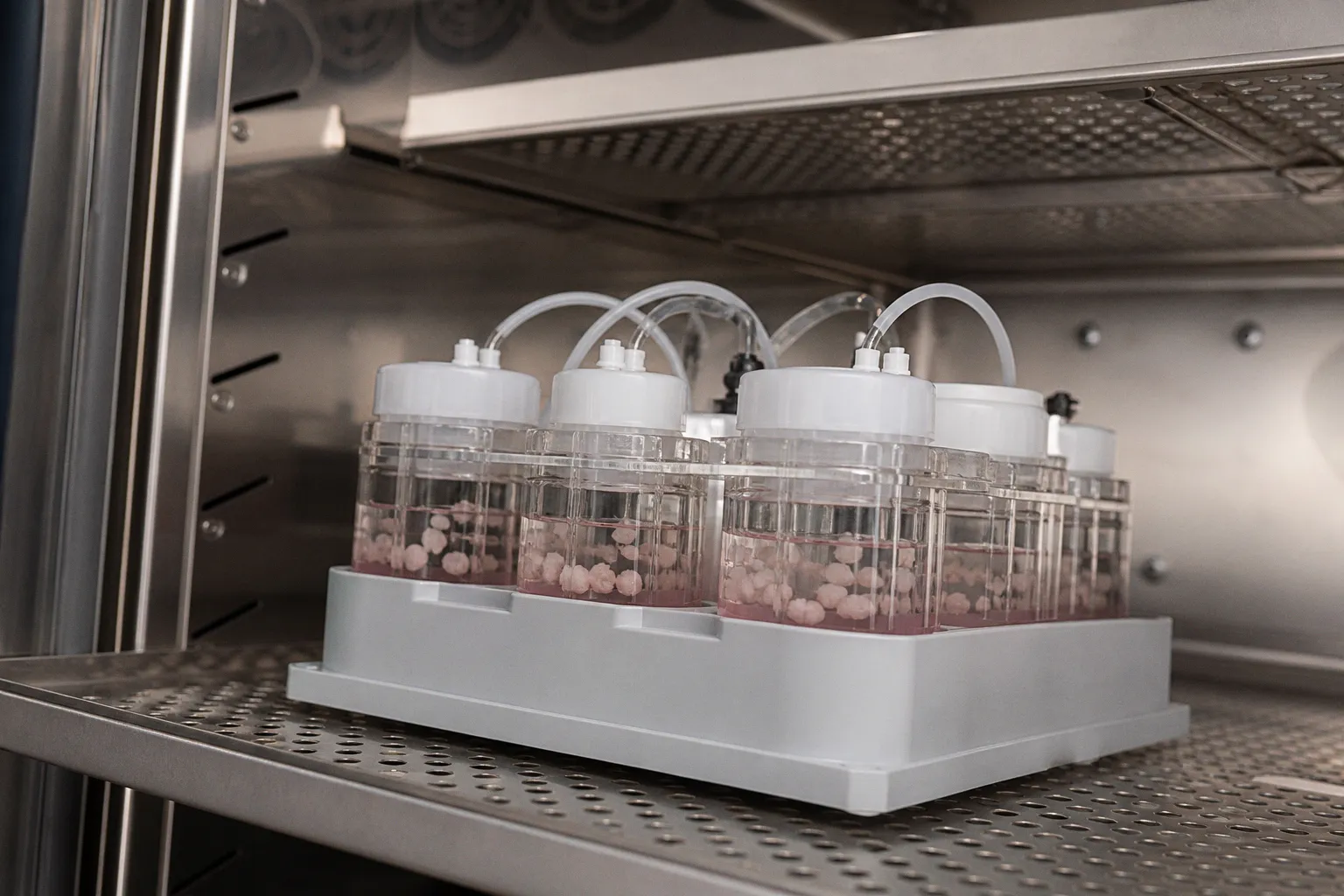
You know that moment when your zebrafish larvae hit 5 dpf and the behavior assay you've been chasing just… evaporates? The window slams shut, your clean signal goes noisy, and you spend the next three weeks wondering whether it was your light cycle, your feeding prep, or just the animals being themselves. We've all been there. A new finding from NIH-funded researchers is forcing a parallel conversation in the organoid world, and the implications ripple straight back into how we think about timing in our own in vivo rigs.
According to the National Institutes of Health, scientists have sustained human brain organoids for nearly six years and shown that their maturation is driven by an internal developmental clock that mirrors human brain development. The takeaway is unusually clean: organoids don't just drift toward maturity because we keep feeding them — they tick. And if a built-in ticker survives that long in a dish, the bench-side question for any of us running a vertebrate model is what that means for the clocks we're already measuring between feedings and light shifts.
Why a "clock" matters at the bench
The pitch from the NIH release is simple once you sit with it. Long-term culture lets organoids follow something resembling a built-in timetable rather than being pushed through stages by the media swaps we throw at them. For anyone running a zebrafish prep, this is your temperature-shifted developmental staging, your "why does this animal suddenly look like a juvenile at day 30" puzzle, your steroid-treated maturation timeline — all reframed at once. If maturation runs on an internal oscillator that survives the environment, then a chunk of the variability you've been fighting in your prep might be signal, not noise. What if the tightest, most reproducible behavior data you ever collect comes from respecting the clock instead of trying to override it?
Here's the practical move before your next cohort: stop blaming your feeding schedule when your assay drops off at 5 dpf and instead ask whether the developmental clock itself is closing that window. Log precisely when each clutch hits each milestone — hatching, swim bladder inflation, the first robust optomotor response — and lay those timestamps against your assay outputs. If the organoid folks can hold a system for years while a clock runs, we can at least map the same kind of internal timing onto the much shorter windows our fish give us.
What to watch next
The NIH work explicitly frames long-term organoid maintenance as enabling long-term benchtop studies of neurodevelopmental disorders — disease-model timelines that used to be impossible because cultures collapsed after a few months are now on the table. For zebrafish labs, that's a quiet nudge. Your next prep doesn't need a six-year plan, but it does need you to start treating your "noise" as a possible clock signal worth annotating rather than a flaw to subtract out.
Let's stop treating development as something we push on our animals and start treating it as something we read off them. Your 5 dpf window might just be the clock ticking on schedule — and once you see that, the protocol fixes write themselves.