Mapping Mesoscale Brain Hubs That Drive High-Stakes Decision-Making
A collaborative team from National Taiwan University and the University of Illinois at Urbana-Champaign has mapped the precise mesoscale neural structures that gate different categories of information during rapid, high-stakes decision-making.
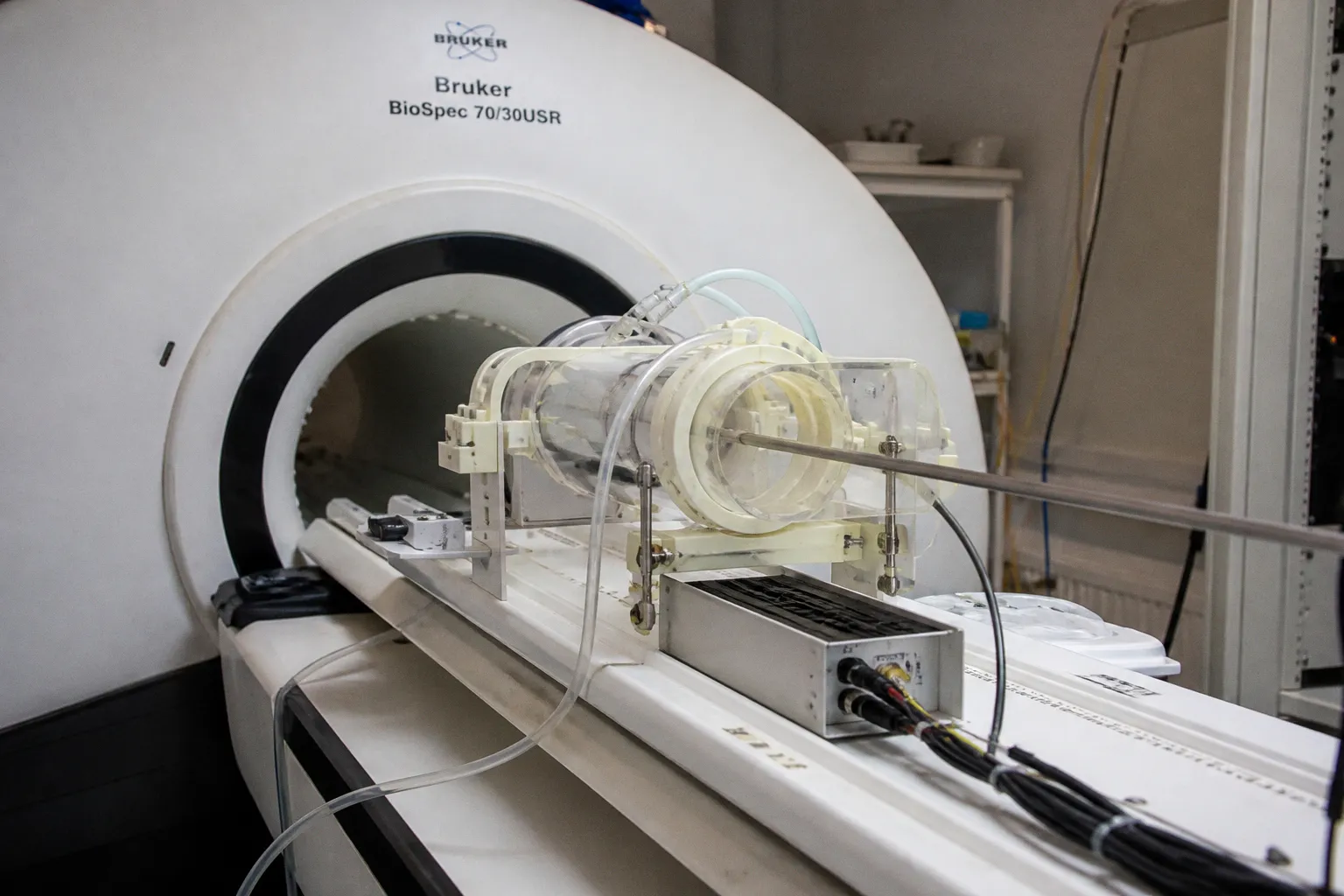
High-Stakes Decisions Route Through Submillimeter Brain Hubs, 7T MRI Study Maps
Published in Nature Communications, the study leveraged ultra-high-field 7-Tesla MRI to resolve functional activity at the hundreds-of-microns scale—structures that conventional 3T scanners blur into a single blob. For anyone working on circuit-level models of adaptive choice and risk processing, this is a calibration milestone: the spatial resolution now matches the anatomical granularity of the structures doing the work.
Wiring Diagram: Locus Coeruleus as the Alarm Relay
The key structural finding isolates a clear two-stage architecture. When subjects encountered high-stakes conditions in a lottery decision task, the locus coeruleus—a brainstem nucleus roughly 2 mm across—fired a signal to the frontal cortex, effectively commanding a shift from baseline to heightened resource allocation. This maps the LC not as a diffuse modulator but as a specific relay that tags salience and triggers cortical reconfiguration.
Within the frontal cortex itself, the team tracked a layer-specific shift: deeper cortical layers engaged during choice formulation, superficial layers during outcome evaluation. At 3T resolution (~3 mm voxels), only broad regional sensitivity to stake value and decision certainty was visible. At 7T, the mesoscale hubs disentangled into discrete functional gates, each handling a distinct information category. Dr. Joshua Goh, co-corresponding author, described the advance as revealing "a series of small structural hubs in the brain that act as functional gates for different kinds of information during a decision."
Why the Resolution Jump Matters for Circuit Research
The practical upshot for the field is straightforward. Conventional 3T fMRI conflates structures that this study now shows operate as separable processing nodes. If your experimental design or clinical targeting relies on distinguishing choice-phase from outcome-phase activity in prefrontal cortex, 3T data will blur the signal. The 7T approach calibrates a tighter spatial map—one that bridges the gap between noninvasive human imaging and the submillimeter circuit diagrams emerging from slice electrophysiology and two-photon work.
Separately, a PET imaging study reported that schizophrenia correlates with widespread loss of synaptic connections, with a pattern tied to molecular and connectivity architecture and a left-hemisphere bias. That finding does not directly link to the 7T decision-making work, but it reinforces the broader signal: circuit-level specificity—where exactly the disconnection occurs—now drives the most actionable interpretations.
What to Track Next
Three parameters to isolate going forward:
- Task calibration for mesoscale targets. The NTU–UIUC team explicitly tuned their lottery decision stimuli to engage structures at the 7T-resolvable scale. Expect other groups to adapt this approach for different decision domains—social reward, threat avoidance, temporal discounting.
- LC–frontal cortex coupling under pharmacological manipulation. The locus coeruleus is a primary norepinephrine source. Mapping how its relay function shifts with noradrenergic agents or stress hormones is the next logical step for translational circuits work.
- Cross-species alignment. With concurrent rodent work tracking experience-dependent decision circuits in mice, the critical calibration task is mapping homologous mesoscale structures across species. The mouse LC is anatomically tractable; the human LC is now functionally resolvable at 7T. Bridging these two datasets will determine how far rodent circuit models can be extrapolated to human choice behavior.