Mapping V1 Spinal Interneurons to Decode the Neural Control of Locomotion
If you've ever tried to untangle which spinal interneuron subtype is actually doing the thing your locomotor assay is measuring, you know the frustration of staring at a tangle of overlapping markers. That bench headache is exactly what the St.
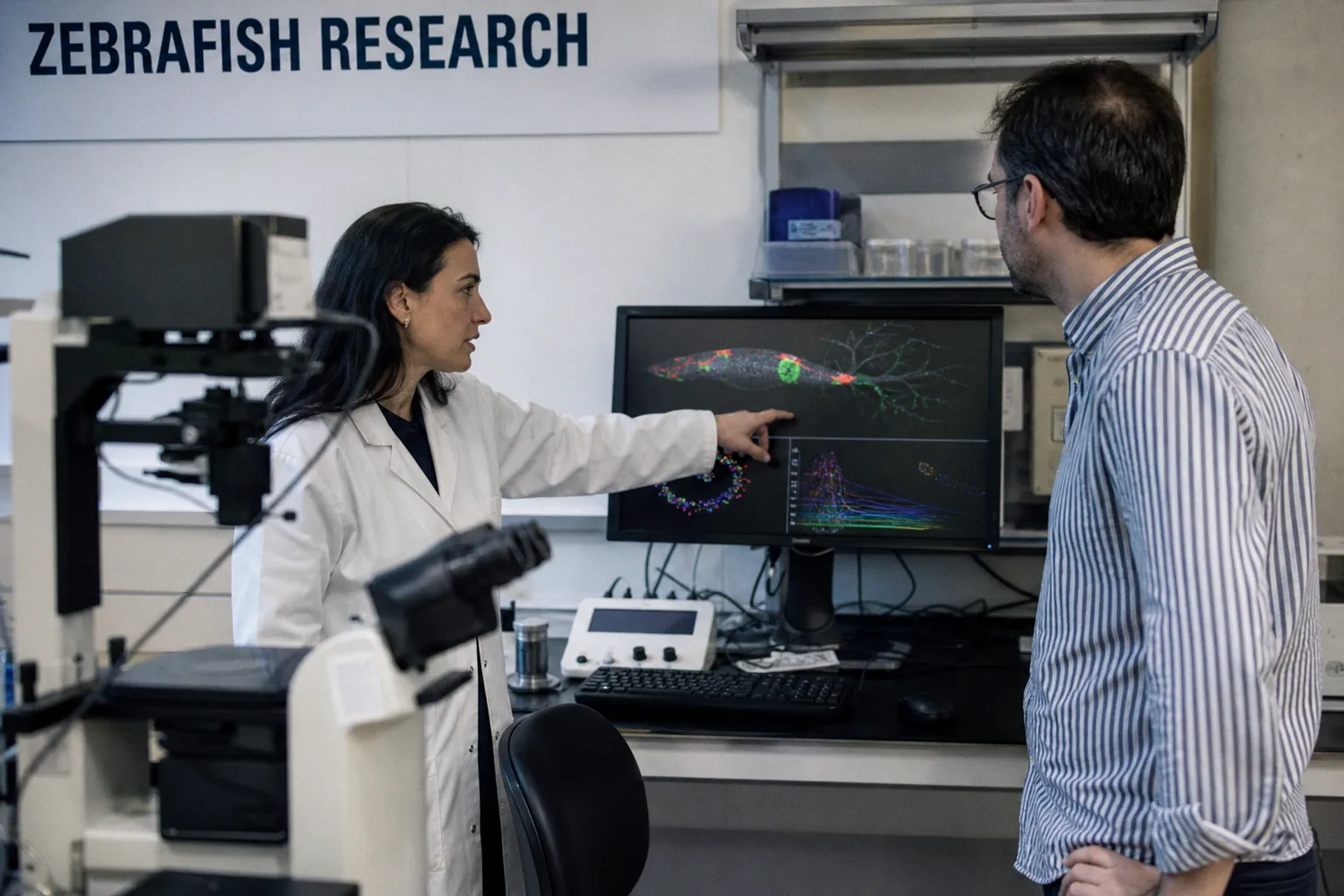
Jude team just chipped away at, and if you're working with zebrafish circuits (or any vertebrate motor prep), the new V1 atlas is worth pulling up before your next experiment.
As reported by St. Jude Children's Research Hospital, scientists there built a single-cell atlas of V1 spinal interneurons and used it to pin a very specific job — controlling the speed of rhythmic movements like walking — to a tiny subgroup they've named V1Pou6f2. First author Alex Trevisan, PhD, and corresponding author Jay Bikoff, PhD, both in St. Jude's Department of Developmental Neurobiology, published the work in Nature Communications.
What the atlas actually gives you
Let's be clear about what was built, because it's not just "more single-cell data." The team ran single-nucleus sequencing on V1 interneurons from a mouse model, clustered the cells by molecular features, and sorted them into discrete subgroups. They then packaged the whole thing as an online, browsable resource for the community. So instead of guessing which of your candidate markers co-segregates with which functional class, you can go query the atlas and ask whether the gene you're about to put on your in situ probe even marks a coherent subgroup.
For us, the practical move is to treat this as a lookup table when you're designing your next screen. Pick your locomotion phenotype first, then go fish in the atlas for V1 subclusters defined by the markers you already have, rather than the other way around. It saves a season of bad sectioning.
The actual biology: speed versus flexion–extension
Here's the part where the literature gets a little sloppy and this paper does some real cleaning up. V1 interneurons have long been known to matter for locomotor rhythm — knock them out and your animal's gait slows and limbs start mis-firing on flexor/extensor timing. The open question was whether the same cells were doing both jobs (speed and the alternation pattern) or whether different V1 subpopulations were quietly splitting the labor.
Bikoff's group compared their atlas against a separate single-cell dataset from mice carrying a key gene deleted specifically in V1 cells. Those mutants show slower locomotor rhythms but no hyperflexion — clean dissociation. Cross-referencing the two, exactly one V1 cluster was missing: V1Pou6f2. Their conclusion, in Bikoff's own framing, is that slowed speed and flexor/extensor defects are separable, with V1Pou6f2 specifically carrying the speed dial and leaving the alternation circuitry to other V1 neighbors.
That separation matters for anyone building circuit models or trying to rescue locomotion after a lesion. Speed and coordination are not the same intervention target, and conflating them in your readout is exactly the kind of "noise" that kills a clean rescue signal.
What to take back to the bench
A few practical notes, since I know we're all about to plan the next prep:
- Cross-reference your markers against the atlas before you commit to a reporter line. If your candidate gene sits inside the V1Pou6f2 cluster, you're looking at a speed-control assay, not a coordination assay — design the behavioral readout accordingly.
- If your locomotion data is all "the fish is slower," you're probably looking at speed phenotypes; if you see robust alternation defects, you're looking elsewhere in V1 or beyond. This helps you decide which mutant to cross into your line next.
- Keep an eye on follow-ups. Bikoff himself frames the atlas and its use case as a "first step" toward understanding recovery after spinal cord damage — which means more functional dissection of the remaining V1 subgroups is a reasonable bet in the next paper cycle.
Go grab a coffee, pull up the atlas, and let's see whether your favorite V1 marker lives in the speed cluster or somewhere more interesting. Either answer is going to sharpen your next experiment.