Why Climate Neuroscience Must Become a Core Pillar of Zebrafish Research
The Transmitter is running a piece that should make every zebrafish PI sit up and pay attention: neuroscientists are calling for a more integrated, guided framework to study how climate change — and…
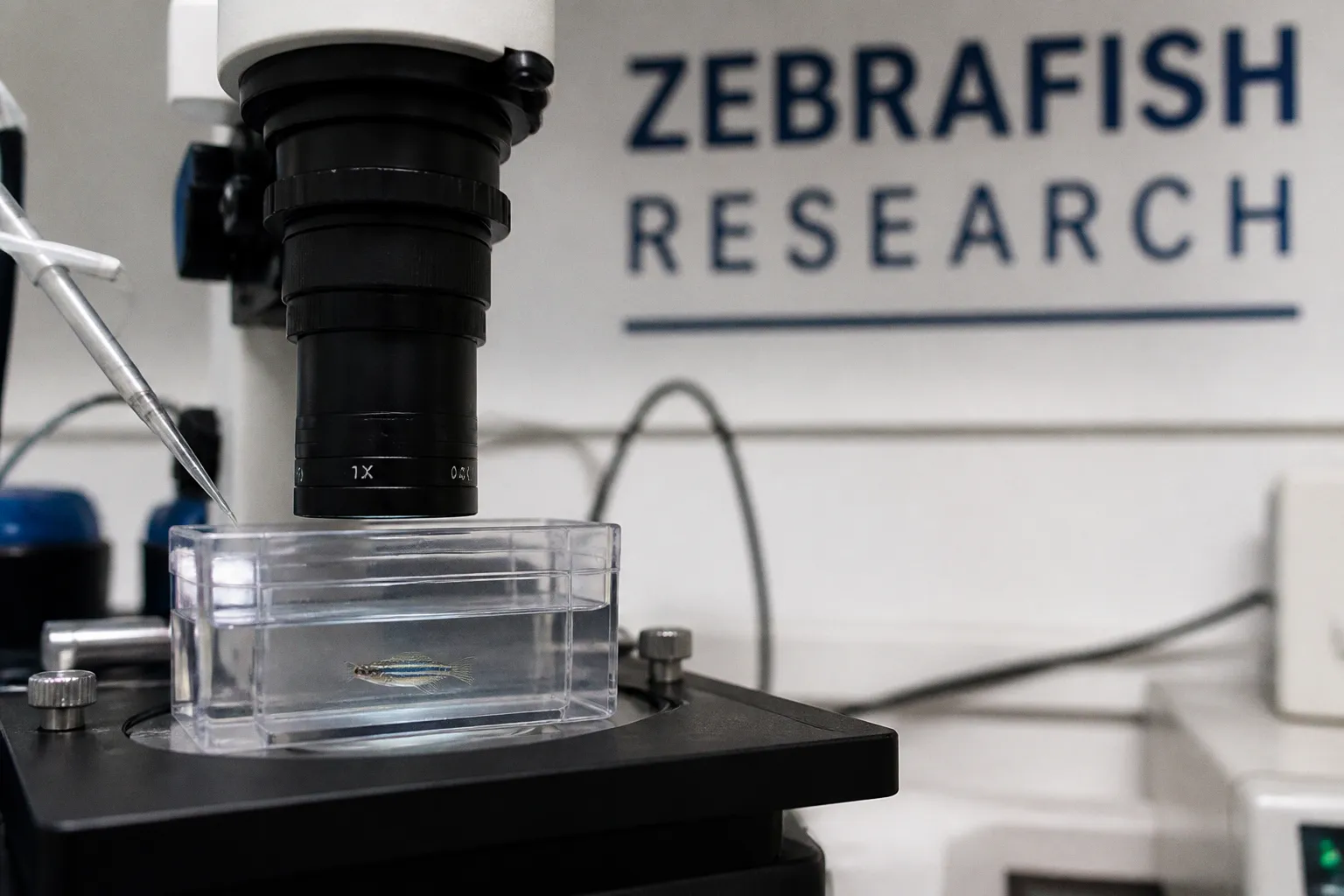
The Transmitter is running a piece that should make every zebrafish PI sit up and pay attention: neuroscientists are calling for a more integrated, guided framework to study how climate change — and especially rising temperatures — are remapping nervous systems across species. If your lab runs any kind of thermal challenge on Danio rerio, this isn't a side conversation anymore. It's about to become the methodological center of your next grant cycle.
Why zebrafish are quietly becoming the anchor species
Let's be honest — zebrafish have always been the "clean signal" organism of choice for circuit-level work, but the climate angle is newer. Florence Kermen at the University of Copenhagen has shown that when zebrafish are exposed to excessive heat, they exhibit behaviors that look like symptoms of brain malfunctioning. That phrase should be tattooed on every climate-rig setup, because it gives us a phenotype we can actually score. We already have the genetic toolkit, the transparent larva, the optical access. The opportunity here is enormous — we just need to start running temperature as a deliberate experimental variable instead of something we're trying to control out of the prep.
What "guided" research actually means at the bench
You can't study every species — Martín Tresguerres at UC San Diego has been blunt about that — but you can study the right ones with the right questions. Angie Michaiel at the Kavli Foundation's Neurobiology and Changing Ecosystems initiative has pointed out that climate work gives us "a whole new form of data that we haven't necessarily considered." Translation: stop bolting temperature onto your existing protocol as an afterthought and start designing experiments where temperature is the perturbation of interest. That's a different prep, a different control structure, and probably a different animal care compliance conversation with your IACUC.
Look at what the comparative labs are already doing and borrow the playbook. Wolfgang Stein at Illinois State University is showing that green crab neurons maintain coordinated rhythms at higher temperatures than their native counterparts — a mechanistic explanation for invasive range expansion. Brady Weissbourd at MIT is recording neural activity in Clytia hemispherica jellyfish larvae while tracking dissolved oxygen and pH alongside temperature. Notice the pattern: it's not "climate as background noise," it's "climate as the variable of interest, with neural readout at single-cell resolution." That's a rig you can stand up in a zebrafish facility this quarter.
What to do in your lab this month
Three things, and don't skip the third. First, audit your current prep — where are you implicitly assuming 28°C is "neutral" and what would change if you treated it as a variable rather than a constant? Second, talk to one comparative physiologist outside your immediate network; the integration the field is asking for happens at the margins of your expertise, not in the center. Third, draft a single aim where temperature is the perturbation and behavior is the readout. You don't need to redesign your whole program. You need one clean experiment that says: yes, we belong in this conversation. We do, by the way. Let's make sure the field hears from us.