How Neural Systems Coordinate When Balancing Conflicting Social Goals
, what happens between two brains learning to create together runs counter to intuition — and joins a broader wave of recent findings, including a News-Medical report on how the brain balances…
According to a study from ETH Zurich's Social Brain Sciences Lab, reported by EurekAlert!, what happens between two brains learning to create together runs counter to intuition — and joins a broader wave of recent findings, including a News-Medical report on how the brain balances competing goals, that are sharpening the picture of how neural systems coordinate under conflicting demands.
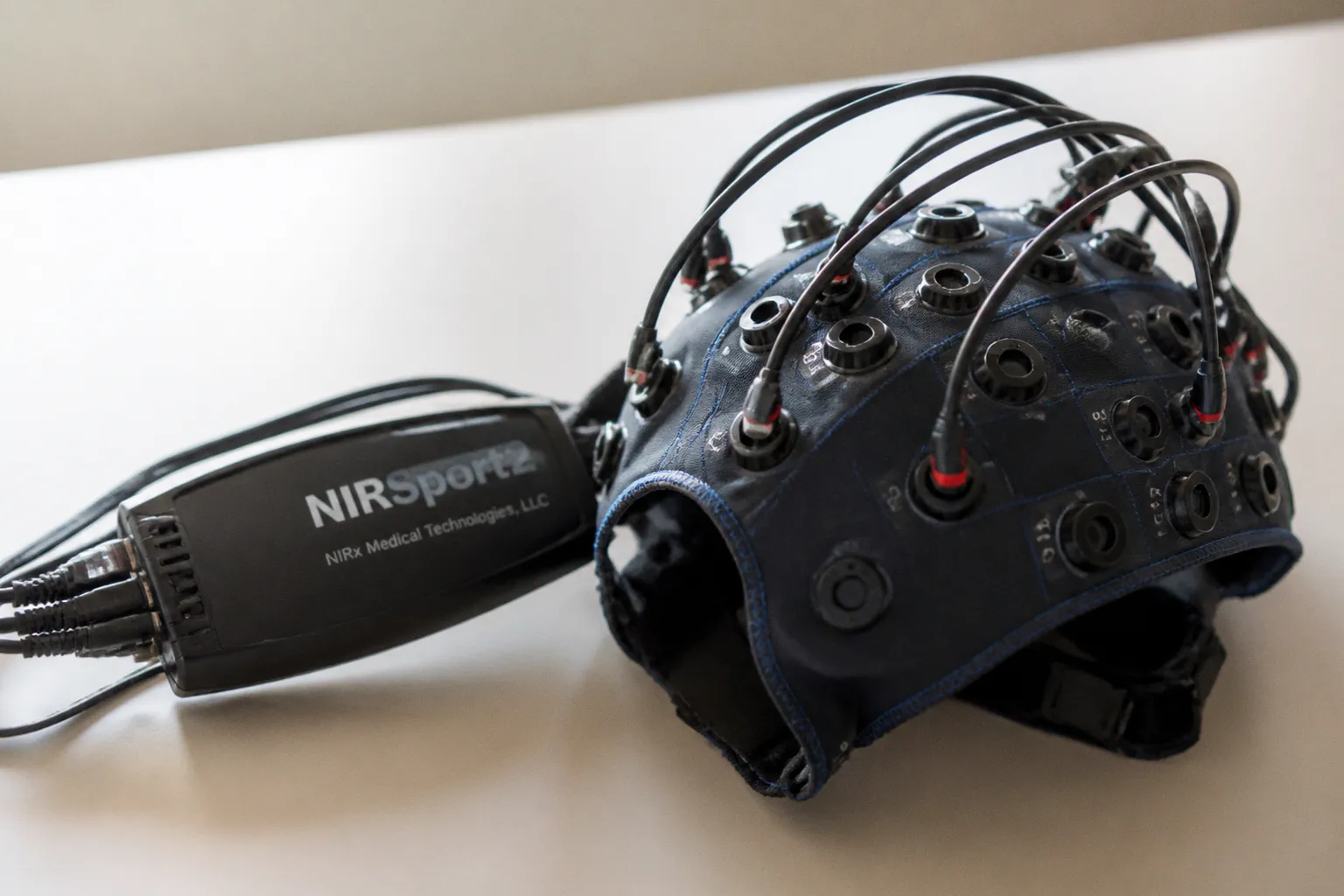
The ETH team, led by postdoctoral researcher Ryssa Moffat, used wearable fNIRS sensors to record brain activity in 61 pairs of participants. The dyads were split between same-age groupings and cross-generational pairs, with one partner aged 18–35 and the other 70–85. Over six weekly sessions, participants first drew individually, then together twice on a single shared sheet. Sensors measured changes in blood flow throughout, while motion-tracking captured the physical choreography of their drawing hands.
The premise was straightforward: as familiarity grows, brains should align. Prior work on inter-brain synchrony suggested that the more comfortable two people become, the more their neural firing patterns mirror each other. Moffat's data complicate that assumption. In cross-generational pairs, synchrony was higher at the start of the study and decreased week by week — even as participants reported feeling closer to their partners. The neural and the social did not move in lockstep.
Coordination Within and Between Circuits
The finding lands inside a wider current of neuroscience asking how networks balance competing goals — a thread surfacing this week across multiple outlets, from studies suggesting supportive glial cells may drive cognitive decline to reports that peripheral inflammation may damage the brain in rare disorders.
For researchers studying circuit formation — whether in mammalian cortex or in the transparent, genetically tractable nervous system of the zebrafish larva — the principle generalizes. A circuit is rarely a chorus. It is a layered arrangement of populations with overlapping but distinct objectives: one ensemble encoding context, another driving action, another gating sensory input. Effective behavior emerges not from uniform synchrony but from precisely patterned coordination across these layers.
The Moffat result offers a human-scale mirror of that principle. Two people learning to create together are, in effect, two networks negotiating a shared state space. Synchrony at the outset may reflect initial uncertainty — both brains searching for the same scaffolding. As the relationship matures and each participant develops more individual creative habits, the shared signal may fragment, not because connection has failed, but because the systems have specialized.
Reading the Curve Differently
The practical takeaway for anyone designing or interpreting neuroscience experiments is to resist treating synchrony as a proxy for rapport or success. The data suggest the opposite may sometimes hold: early synchrony can mark inexperience, while later divergence can mark the emergence of differentiated roles.
For data visualization, the implication is sharper. When plotting inter-brain correlation across time, the curve that looks most intuitive — rising with familiarity — may be the wrong curve to design for. The study effectively provides a corrective: track specialization, not just convergence. Two signals that diverge cleanly may be doing more interesting work than two signals that drift together.
What remains to be watched is whether the same pattern holds in same-age pairs over longer intervals, and whether the decrease in synchrony across cross-generational dyads reflects a ceiling, a transition, or simply a different geometry of creative partnership. For the zebrafish lab bench, the underlying question is the same one Moffat's participants enacted with pencil and paper: how do neural systems learn to coordinate without losing their individual architecture?