How Zebrafish Spinal Circuits Orchestrate Collective Schooling Behavior
If you've ever watched a tight shoal of zebrafish pivot as one and wondered who's actually calling the cues, a fresh preprint out on arXiv is going to make you lean a little closer to your scope.
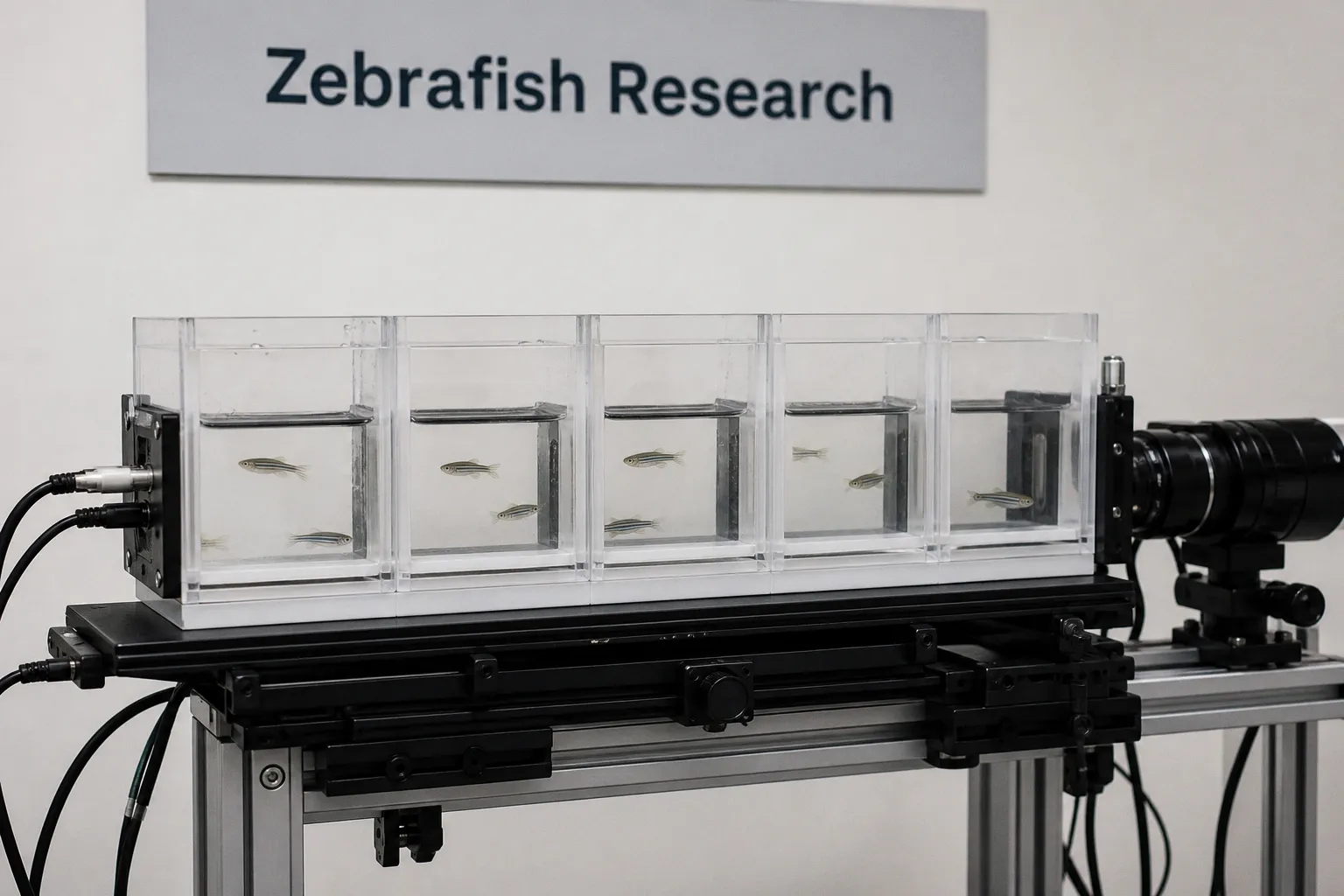
Researchers report a low-order spinal sensorimotor circuit that lets schooling fish coordinate in real time, with intraspinal proprioceptive neurons quietly carrying both self-generated and neighbor-induced bending signals. Read that twice — because if you work with zebrafish, this is the kind of paper that changes how you design your next prep.
The circuit, in bench-language
Let's break it down the way you'd talk about it over coffee at the rig. The team identifies a low-order sensorimotor circuit sitting in the spinal cord, and the star players are intraspinal proprioceptive neurons. These cells are encoding two flavors of body bend: the kind the fish makes on its own, and the kind it makes because the neighbor just flinched. So the spinal cord isn't just executing brain commands — it's actively fusing sensory feedback from itself and from its tankmates. When the authors disrupted this circuit optogenetically, coordinated schooling was abolished. The fish were still swimming; they just stopped swimming together.
Why this matters for your fish room
Here's where it gets practical for anyone running group-behavior assays. If you're imaging tail bends at high frame rate to quantify social cohesion, you've probably been treating "fish-generated bend" and "social bend" as separate events in your analysis code. That's a reasonable first pass, but this work suggests the spinal cord is doing the integration before the brain even weighs in. So your "self" vs "social" classifier might be splitting a signal that the animal never actually splits. Before you chase that next behavioral phenotype, it might be worth re-running a session with the proprioceptive channel in mind — ask whether your kinematics pipeline is dropping the very coupling signal that drives the behavior you're scoring.
What to keep on your radar
The disruption result is the headline you should pin to your bench whiteboard. Optogenetic silencing of this spinal circuit is enough to break schooling, which puts a spinal sensorimotor module — not a brain command — at the heart of the most charismatic zebrafish behavior we image. Watch for the full paper, and keep an eye out for whether the same proprioceptive class shows up in larval and adult stages, and whether stress, anesthetics, or your standard NMDG-free prep protocol change how cleanly that signal survives. This is exactly the layer of the circuit we should all be probing next.