Optical Tweezers Bypass Speakers to Control Zebrafish Heart Rates via Otoliths
According to ScienceAlert, a team led by physicist Xiaoshuai Liu of Guangzhou University just published a workaround that's going to make you rethink your whole stimulus path: they used a laser to…
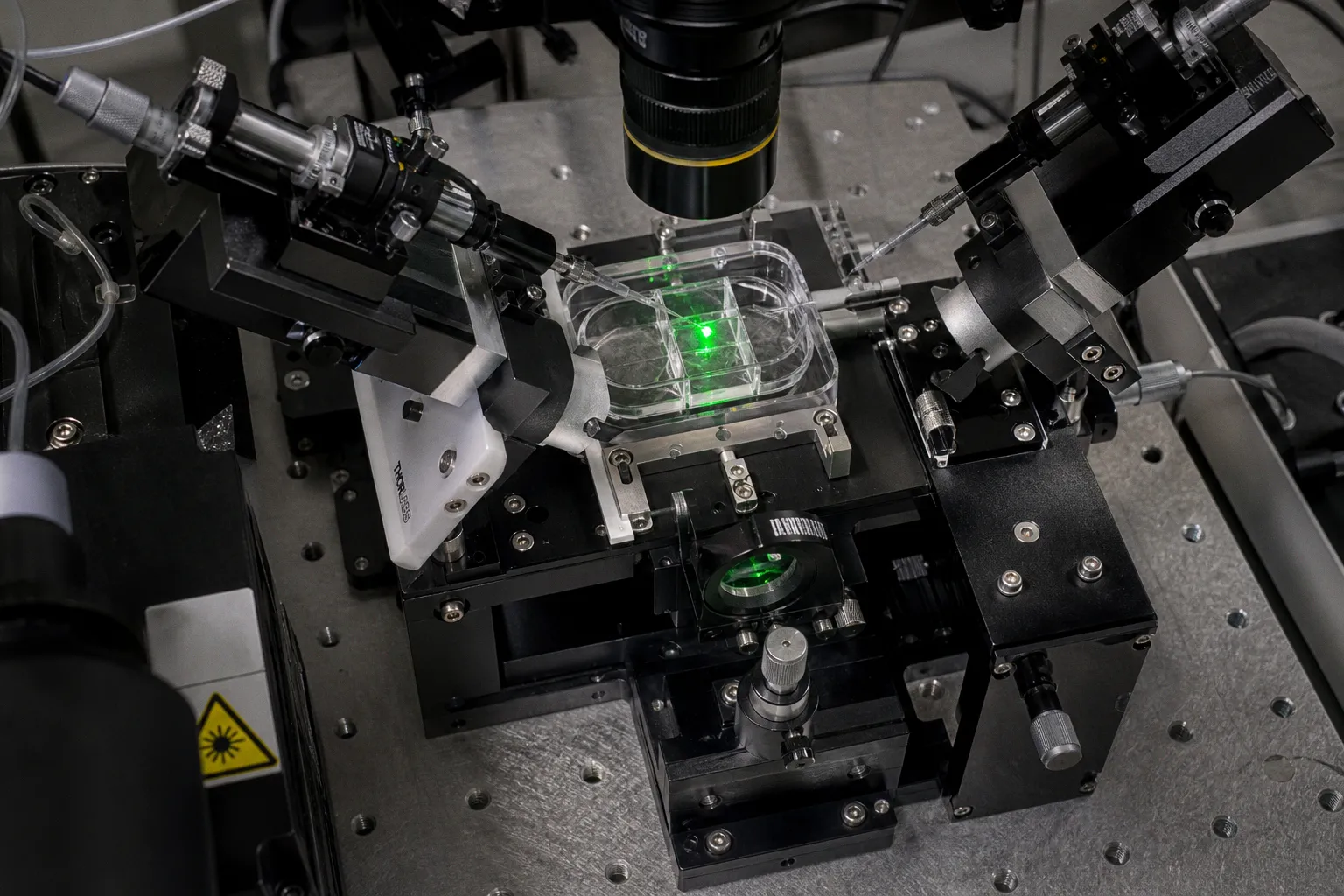
You've spent half a day prepping zebrafish larvae for a heart-rate assay, and now you're squinting at a noisy trace wondering if the artifact is your rig or your fish. According to ScienceAlert, a team led by physicist Xiaoshuai Liu of Guangzhou University just published a workaround that's going to make you rethink your whole stimulus path: they used a laser to wiggle the otolith directly, bypassed the speaker entirely, and watched the fish's heart speed up.
It's one of those papers that makes you put down your pipette and read it twice.
How they pulled it off
The researchers used optical tweezers — focused laser beams that physically trap and manipulate microscopic objects — to oscillate individual otoliths in living zebrafish larvae. Otoliths are those tiny calcium carbonate crystals sitting in the fish's inner ear; when sound or motion nudges them, they activate the sensory hair cells that feed the auditory circuit. So the team skipped the air, the speaker, and the speaker calibration — everything that makes acoustic stimulation in larvae such a headache — and just shoved the otolith directly. While they were at it, they imaged brain activity and watched the auditory-related regions light up.
Then things got interesting. Move the otolith, and the heart rate climbs.
Why this matters for your bench
Liu told ScienceAlert the whole idea was born from music therapy — if rhythmic sound can modulate cardiac rhythm, the team wondered whether precisely programmed light could do the same. The goal, he explained, was to break free of the convention that pairs light with vision and sound with hearing: any oscillation, the team argues, can be made to function as sound if you drive it precisely enough.
For anyone running auditory circuits in zebrafish, the practical punchline is the second finding in the paper: the same optical stimulation rescued drug-induced cardiac arrhythmias in the larvae. That's not just a cute optogenetics-adjacent trick. It's proof you can drive a vertebrate autonomic response by mechanically actuating a single, well-defined sensory structure — no acoustic pathway required.
Think about what that buys you at the bench. Cleaner stimulus onset. No speaker coupling artifacts. A clean way to dissociate the auditory circuit from the mechanical pressure component of your stimulus. If you've ever fought a rig where the "sound" is also a pressure wave that touches the body wall and contaminates your cardiac trace, you know exactly why this matters.
What to watch — and try
The team is upfront about the limits. As Liu put it, echoing the old Zhuangzi line — "you are not the fish, how do you know the fish's joy?" — we have no way to confirm whether the larva is consciously "hearing" the light. What we can confirm is the clean downstream activity in auditory centers and the reliable heart-rate modulation.
So before you start shopping for an optical-tweezers rig, ask yourself one question: does my current auditory prep have a coupling artifact I keep blaming on the fish? Because the workaround just hit preprint, and your next positive control might be a laser.