Cultivating Future Neuroscientists Through Intensive Undergraduate Research Rotations
Bryn Mawr College funded 92 undergraduates for 10-week, faculty-led research stints this summer, according to the college's own announcement of its Summer Science Research 2026 program.
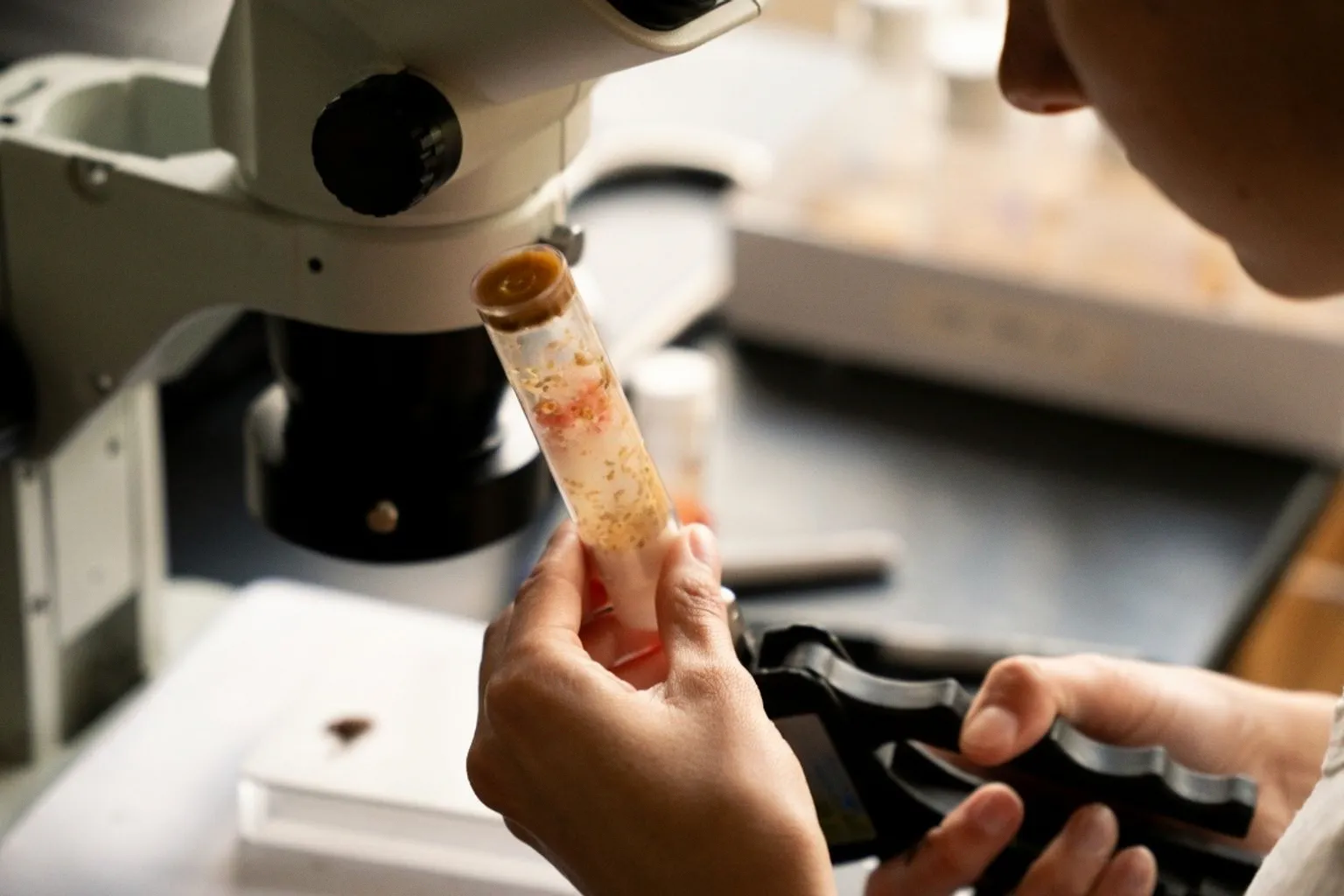
For a neural-circuitry audience, the signal sits in the training pipeline — this is the calibration floor where the next cohort of bench scientists, including future circuit-mappers, gets built.
The rotation, mapped
Each student worked under a single faculty principal investigator on an independent project in the sciences and mathematics. The format is the point: extended contact with one PI, ownership of a defined experimental question, and direct access to departmental core instrumentation.
In the Vasileiadou chemistry lab, undergraduates worked on light-emitting compounds aimed at solar cells, batteries, LEDs, and medical imaging. Lucie Burgess '28 characterized components for fluoride-ion batteries; Leena Dzemaili '28 synthesized silver telluride quantum dots for biomedical imaging; Monica Anderson '27 measured luminescence of colloidal quantum dots on a new departmental fluorimeter that reaches into the near-infrared; Aden Noor '27 used the same instrument's solid-state sample holder on perovskite crystals.
In geology, Professor Arlo Weil and Ava Purser '28 spent two weeks in the Utah desert sampling Triassic red sandstones and Jurassic limestones, measuring structural features that record tectonic force directions from roughly 70 million years ago and collecting core samples for lab analysis of paleo-tectonic shortening and vertical-axis rotation.
Calibration parameters worth borrowing
The methodology is portable across disciplines. In the Bryn Mawr release, Burgess said she "definitely wanted to find a school that had undergraduate research opportunities," and that "this experience had been exactly what I was looking for." Dzemaili added: "What you learn in the classroom doesn't always exactly translate to what happens in a lab."
Three parameters to isolate for any circuit-lab rotation:
- A defined experimental question owned by the student, not absorbed into a technician role on the PI's main project.
- Direct time on a core departmental instrument — a fluorimeter here, a two-photon rig or electrophysiology setup in a wiring lab.
- A short feedback loop, measured in weeks not semesters, where failure is visible and supervised.
What to verify next
Two numbers to isolate before any practical inference. The stipend model: 92 slots depend on sustained institutional funding; replication at peer institutions requires endowment math the release does not publish. Instrumentation density: the new fluorimeter signals departmental capex, the rate-limiting input for hands-on student training. The open variable is whether Bryn Mawr publishes cohort outcomes — publication rate, conference presence, grad-school placement — to benchmark actual yield. Two adjacent institutional headlines are worth tracking in parallel, per their public titles only: a KACST–Imperial College London extension of their quantum-brain-research collaboration, and a Science Daily item on a human-only gene linked to brainpower. Both signal sustained investment in brain-specific tooling, but neither has published details in the current evidence set.