How the Thalamocortical Loop Compares Past Sensory Input to Drive Current Decisions
A team at MIT's Picower Institute has traced a thalamocortical loop that compares the immediate past against current sensory input, then uses the delta to steer decisions.
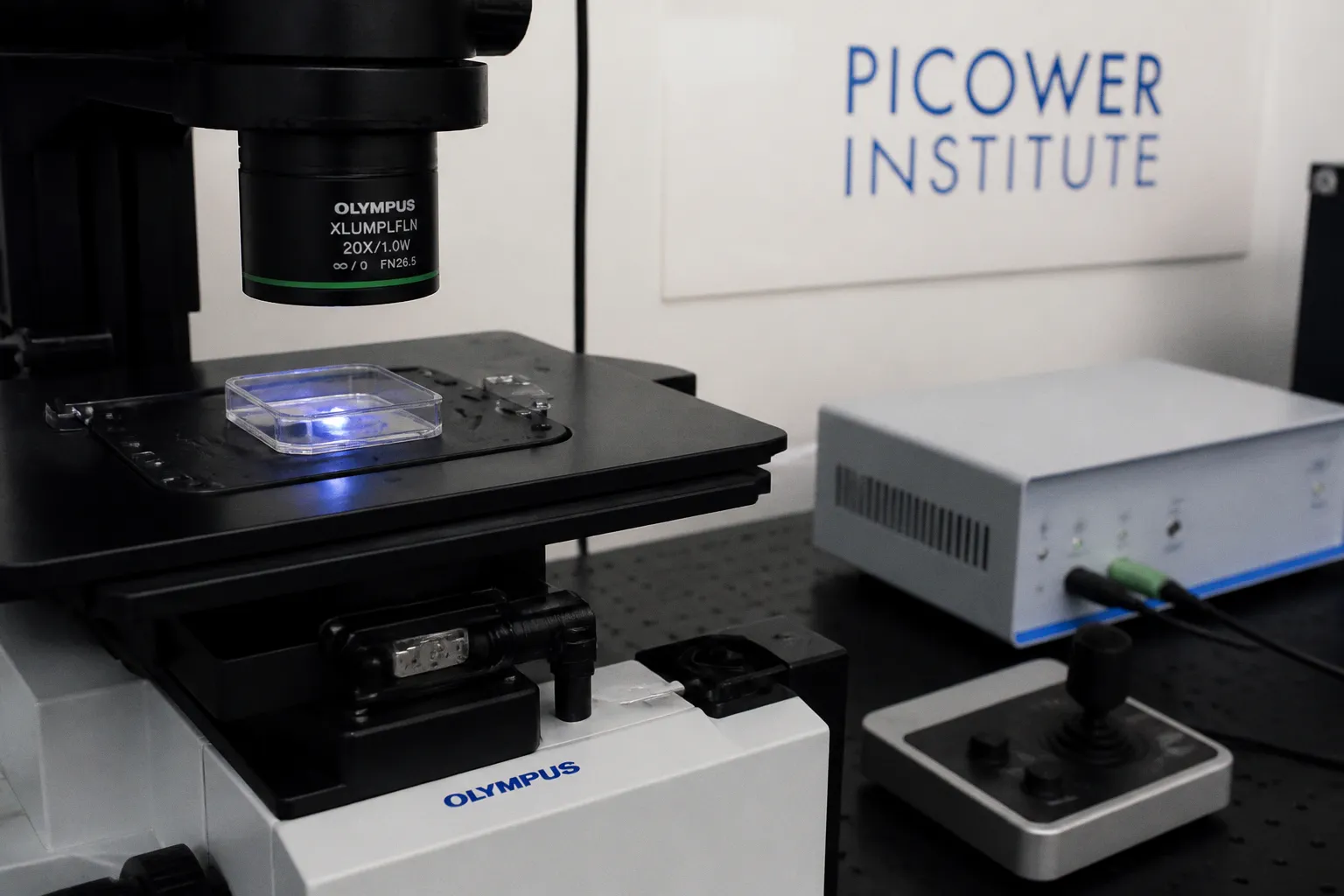
The work, published in Science, isolates the lateral posterior thalamus–anterior cingulate cortex (LP–ACC) circuit in mice and maps its role in change detection. For circuit labs modeling sensory integration — zebrafish included — it delivers a structural reference and a clean behavioral assay to calibrate against.
The wiring, stripped down
LP, the mouse analog of the primate pulvinar, projects to ACC. ACC issues the choice. LP feeds it a running signal about how much the sensory world just changed. The combined output lets the brain decide whether to hold a current choice or update it.
Earlier work treated LP as an attention filter for visual signals. This study extends the role: LP carries a comparison between the just-past and the present, used to flag meaningful change.
How they read it out
Mice ran a random-dot kinematogram task. A variable fraction of dots drifted coherently left or right; coherence and direction both shifted trial to trial. The animal had to integrate current evidence against the prior trial's statistics.
That design isolates the history-weighting computation. Coherence is the experimenter's knob — sensitivity to prior trials can be quantified at each level.
Calibration points for your bench
- Map the homolog. In zebrafish, identify thalamic nuclei that project densely to a cingulate-like region. The MIT group's 2022 input-mapping paper is a starting template.
- Quantify history effects in your existing behavioral data. Do not attribute trial-to-trial variance to stimulus processing alone until prior-trial contribution is measured.
- Do not reduce LP function to "attention." The data here add a change-detection role. Acute perturbation studies need both axes controlled.
- Replicate the dot-task protocol. It is portable across rodent and fish setups with minor optics adjustments, and it gives a quantitative readout of prior-trial weighting.
Where to slow down
The authors flag autism as a downstream application — predictive differences and filtering of recurring stimuli are altered in many patients on the spectrum. That is a hypothesis to test in a disorder model, not a settled mechanism. Build the behavioral bridge first; map the circuit only after the phenotype replicates cleanly.
The blueprint is now public. Treat it as one. Verify the projections, replicate the assay, then decide whether your system runs the same comparison machinery.