Mapping the Neural Circuits That Govern Our Sense of Agency
According to a new study from the University of Oxford combining fMRI and TMS, researchers have fingered two prefrontal–subcortical loops — one of them linking the dorsomedial prefrontal cortex to…
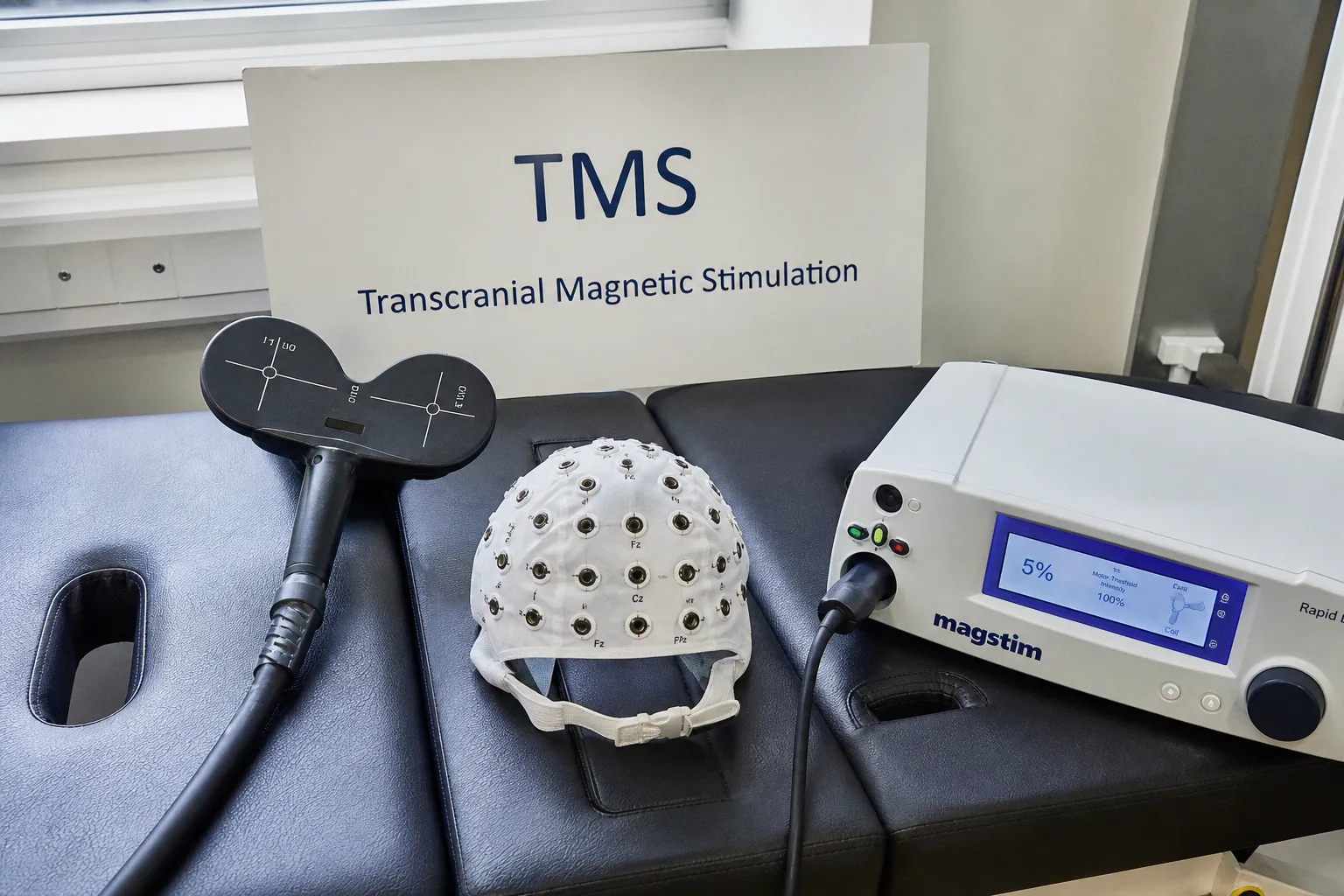
That head-scratcher you've had about decision-making circuits? Two fresh papers just dropped that give us something to chew on. According to a new study from the University of Oxford combining fMRI and TMS, researchers have fingered two prefrontal–subcortical loops — one of them linking the dorsomedial prefrontal cortex to the dorsal raphe nucleus — that help humans estimate whether they can actually control what's happening around them. And over at MIT News, the Sur lab has pinned down a thalamus-to-cortex comparison circuit that does something strikingly similar in mice: it weighs the immediate past against the now, so the animal can decide whether to hold a choice or update it. If you're a zebrafish neurobiologist, you already see why these matter — these are the kind of conserved decision circuits we chase in our fish every week at the scope.
Two circuits, one question
The Oxford work is the conceptual headline: humans judging their own controllability over outcomes, with a dmPFC–dorsal raphe loop doing heavy lifting. That is a serotonergic hub talking shop with a prefrontal executive region — exactly the kind of dialogue your zebrafish serotonergic studies have been poking at for years. The team is suggesting that distortions in this loop could explain why some psychiatric conditions warp a person's sense of agency. We are not running fMRI tomorrow, but the wiring logic is universal. The MIT paper, out in Science with Ning Leow PhD '23 as lead, nails the cellular version in mice. As Sur frames it, the LP–ACC circuit "organizes a comparison between what has just happened versus what is happening now in the sensory world in a manner that can be used to act." The pulvinar's traditional résumé was attention filtering; turns out it is also a change-detector quietly advising the cortex. That is a rework of an old circuit diagram, full stop.
What to pull into your zebrafish prep
Here's where I want you to think like your fish, not like a mouse or a scanner subject. The dorsal raphe is serotonergic, and zebrafish have a stunningly well-mapped raphe — transparent head, clear dorsal view, calcium indicators that just sing under the right prep. If humans estimate controllability through a dmPFC–serotonergic handshake, what's the homologous handshake in the larval zebrafish? That is a question worth raising at your next group meeting, on a slide if you can stomach it. For the MIT-style comparison circuit: your fish already run dot-motion tasks adapted from rodent assays, and the thalamic relay logic (LP to ACC analog) maps onto habenula and thalamic nuclei we routinely image. If your rig has the optics and a clean perturbation setup — targeted optogenetics, two-photon ablation, whatever you trust — you are positioned to ask the exact same comparison question at single-cell resolution in a vertebrate where every relevant neuron is right there in the window.
The clean signal you're after
Both papers hammer the same methodological point, and this is the one I want you to take back to the bench today. To read out decision bias, you need a task where the recent past and the immediate now are experimentally separable. Oxford used controllable versus uncontrollable outcome manipulations; MIT used trial-to-trial coherence shifts in drifting dots. Your fish can run both flavors — controllable versus uncontrollable optogenetic drive of a tectum-downstream pathway one week, and coherence-stepped visual flow assays the next. Pull this into your prep, sketch the trial structure on the whiteboard, and let's see what your fish have to say about controllability before someone else beats you to the prep.