How the Brain Uses Past Sensory Experiences to Shape Present Decisions
A mouse study from MIT identifies a specific thalamus-to-cortex loop that tracks the immediate past to bias present-moment sensory decisions.
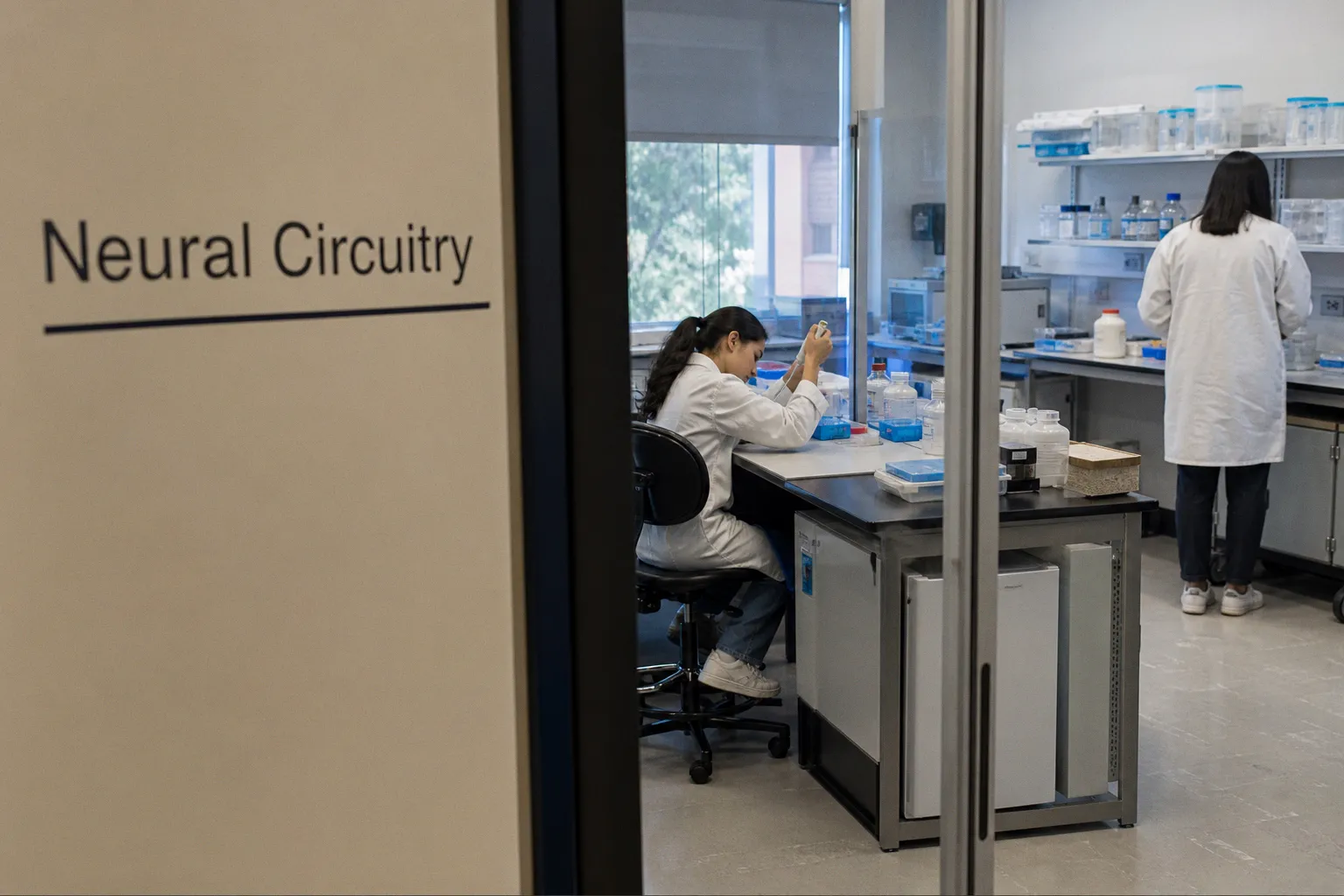
According to EurekAlert!, the work published in Science from the lab of Mriganka Sur points to a circuit linking the lateral posterior thalamus (LP) to the anterior cingulate cortex (ACC) — the rodent analog of the human pulvinar-prefrontal pathway.
The bottleneck and the circuit that resolves it
The cortex cannot evaluate each new sensory event from scratch. It must compare fresh input against a short window of recent history to decide whether to maintain or update a current choice. Senior author Mriganka Sur and lead author Ning Leow (now a postdoc at A*STAR in Singapore) frame this as a comparison between what just happened and what is happening now, executed in a form usable for action.
The LP-to-ACC pathway is the candidate substrate. The lab's 2022 mapping study had comprehensively catalogued inputs to this circuit, leaving its functional role anchored to attention. The new findings reframe that attention machinery as a comparator — the pulvinar, Leow notes, is not just a passive filter but a structure that highlights meaningful change.
How they isolated the signal
Mice were trained on a two-alternative motion discrimination task. A variable fraction of drifting dots moved coherently in one direction; the animal had to report which. Trial-to-trial variation in both direction and coherence forces the system to weight recent outcomes against current evidence — a clean design for quantifying how prior trials bias current choices.
The data indicate that LP maintains a running trace of recent sensory change and forwards that estimate to ACC, where it modulates the decision criterion. The circuit, in Sur's framing, organizes a comparison between past and present in a manner that can be used to act.
What this gives a working lab
For groups studying cortical integration or sensory decision-making, the result supplies a defined microcircuit to target. The authors also flag autism as a downstream application: patients often fail to discount recurring, predictable stimuli, suggesting disrupted weighting of recent versus current input. The LP-ACC pathway becomes a specific node for probing that imbalance.
Parameters to track in follow-up work:
- Manipulation targets: LP axons projecting to ACC; ACC pyramidal neurons receiving LP input.
- Behavioral readout: choice accuracy and reaction time as a function of prior-trial coherence and outcome.
- Controls to isolate: stimulus timing, reward contingency, side bias.
- Cross-species check: confirm analogous pulvinar-ACC connectivity in human imaging data before extrapolating.
The study delivers a defined circuit, a validated task, and a clear hypothesis. The next step is perturbation: silence LP→ACC during specific post-trial windows, then measure how the decision criterion shifts.