How Zebrafish Motoneurons Rewire to Master Coordinated Swimming
According to work from Professor Tuan Bui's lab at the University of Ottawa, the difference between those jerky early wiggles and smooth, mature swimming comes down to predictable electrical rewiring…
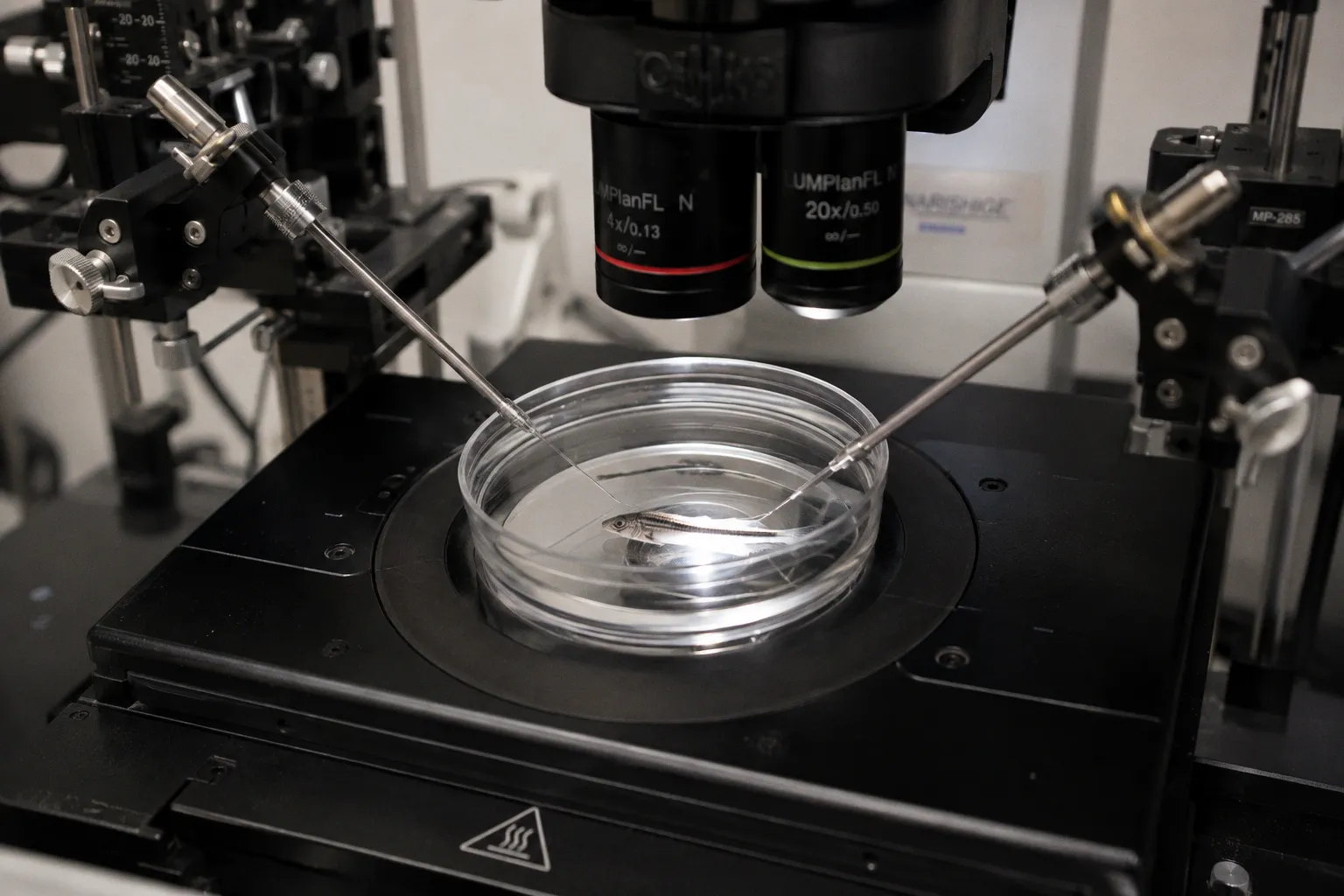
If you've ever watched a larval zebrafish flailing its tail at 5 dpf and thought, "there's no way that chaos becomes a coordinated swimmer in a few days" — you're not wrong, but you might be underestimating the ion currents doing the heavy lifting behind the curtain. According to work from Professor Tuan Bui's lab at the University of Ottawa, the difference between those jerky early wiggles and smooth, mature swimming comes down to predictable electrical rewiring inside motoneurons — the very cells you and I spend half our prep time chasing with patch electrodes.
What actually changes inside the cell
The Bui team, with postdoc Stephanie Gaudreau driving the electrophysiology, didn't just record spike rates and call it a day. They went after specific ion currents in identified motoneurons at precise developmental windows — the moments when a larva first starts trading wild flicks for slower, coordinated bouts. What emerged across three peer-reviewed papers is a picture of currents shifting in distinct, almost choreographed patterns as the animals mature.
"We show that the refinement of movement in growing zebrafish hinges on changes in ion currents that shape how motoneurons work," Bui explains, and his lab identified that these currents evolve in very particular ways during development, letting motoneurons adjust as the animals get better at moving. The M-current paper, published in the Journal of Neuroscience in August 2026, is the centerpiece, with companion work in The Journal of Physiology mapping opposing persistent currents and a ScienceDirect study characterizing calcium current contributions to firing behavior.
Why this matters at your bench
Here's where I want you to slow down, because this is the bit that changes experimental design. If you're doing any kind of developmental electrophysiology on zebrafish motoneurons, the age of your animal is no longer background metadata — it's a primary variable. The currents you're recording at 2 dpf are not the currents you're recording at 5 dpf, and pooling them across a wide developmental window is going to inject exactly the kind of noise that buries a real one.
You already know this in theory, but Gaudreau's team shows it in the data: timing your recordings to the fish's motor milestones — when new, more controlled movements appear — is what lets you link intracellular shifts to behavioral output. Skip that timing, and you're left correlating averages to averages, which is the bench equivalent of shouting into a fume hood and hoping for an echo. As Gaudreau puts it, by mapping out the shifts in individual ion currents from specific motoneurons, they could see how changes inside the nerve cells matched up with the fish getting better at swimming.
What's worth tracking next
Bui is careful to flag the cross-species angle — because so many neural mechanisms are shared across species, the work could help explain how humans get better at moving after birth, and may even help pinpoint which ion currents are most important for movement and how they do their job. For us in the zebrafish world, the practical queue is short: check whether your current dataset actually respects developmental staging, ask whether opposing persistent currents might be canceling out your M-current read, and decide whether calcium current characterization is the missing slice in your analysis pipeline.
Three papers, one consistent story — motor refinement isn't a software upgrade, it's a hardware rebuild, current by current. If you've been calling certain developmental data "noisy" lately, before you blame the rig, ask whether you've really been recording the same cell at the same age.