Tether Evo Breakthrough Eliminates Calibration Bottlenecks in Brain-Computer Interfaces
TechCrunch's reporting on the work details three demonstration tracks — speech, vision, and music — instead of rebuilding a separate decoder for each new patient.
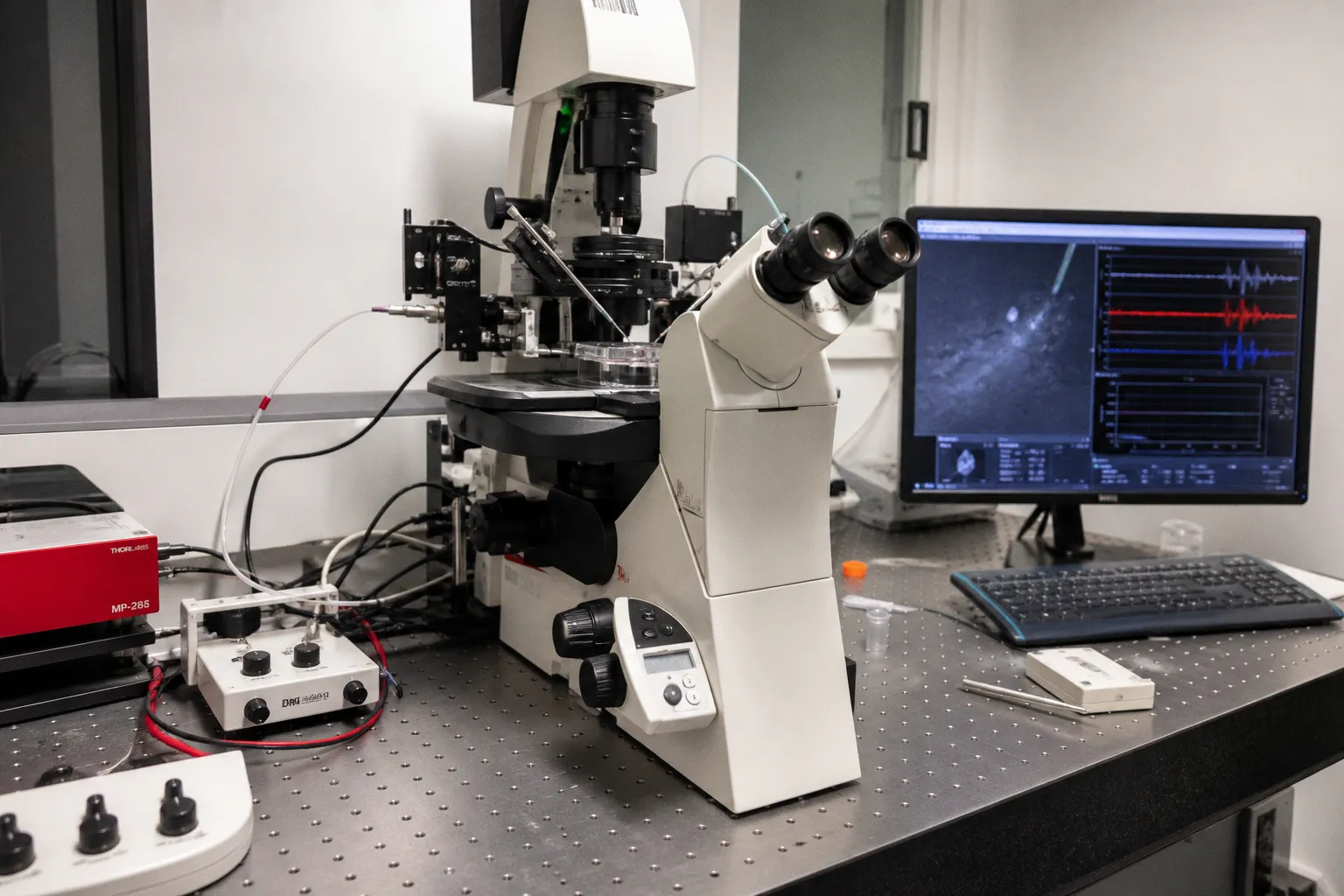
Tether Evo has placed three peer-reviewed papers showing that a single decoding model can read brain activity across different people — collapsing the per-patient calibration bottleneck that has gated clinical brain-computer interfaces.
Two of the papers were developed jointly with the University of Rome Tor Vergata. Acceptance comes from the Journal of Neural Engineering, Imaging Neuroscience, and Neural Networks.
The speech pipeline
The speech paper targets neural-to-phoneme decoding for people who have lost speech from ALS, stroke, or brain injury. Researchers trained the model on invasive recordings from participants implanted in distinct cortical regions, treating each brain as a coordinate transform problem rather than a separate dataset. A lightweight mathematical realignment step maps divergent signals into a shared space, paired with a layered decoding network. The result matches or beats single-patient baselines, with calibration collapsing from lengthy per-subject cycles to minutes or hours for a new participant. That single metric — time to first usable decoder — is the one that gates clinical rollout.
Vision and music
In the macaque vision study, Tether Evo and UniTOV collaborators recorded brain signals while animals viewed thousands of images. From 200 milliseconds of neural data, the model identified the exact image out of thousands with 70% accuracy and generated a reconstruction capturing shape, colour, and content. The music track extends the same cross-subject logic into a domain where neural representations diverge sharply between listeners — a deliberate stress test for the realignment strategy.
Why the architecture matters
The engineering move worth isolating is the realignment layer. It treats individual variability — different implant locations, different functional activity, different learning histories — as a transform problem rather than a data-collection barrier. That recasts scaling: deploying BCIs no longer requires a fresh dataset per patient before any useful output exists.
Independent work from Caltech's Andersen lab sharpens the design constraints. Researchers there recorded mirror-like activity in individual human neurons in the posterior parietal cortex of two tetraplegic participants and showed that the effect depends on task relevance rather than firing automatically in motor cortex. The paper, appearing in Cell, tells decoder engineers which cortical region to read from and under what behavioural context signals will actually resolve.
What to track next
For practitioners evaluating neural interfaces, the immediate parameter is calibration time per new participant. If Tether Evo's cross-subject numbers replicate independently, the field has a credible path to scaling BCIs without proportional increases in per-patient data acquisition. Watch for replication cohorts outside the original implant sites, and for performance figures reported on held-out subjects rather than cross-validated within training sets.